If you are wondering how to leave a dog alone with separation anxiety, the safest place to start is with an absence short enough that your dog can remain comfortable—even if that means stepping outside for only a few seconds. Effective separation anxiety training is not about making a dog “get used to” panic. It is about practicing manageable separations below the point where fear escalates, then gradually building duration as the dog becomes more confident.
For some dogs, alone-time training progresses fairly smoothly. For others, especially dogs with established separation-related distress, progress may need to be extremely gradual. The goal is not to follow a fixed timetable. The goal is to teach your dog, through repeated safe experiences, that being alone does not predict something frightening.
Why Some Dogs Panic When Left Alone
A dog who barks, scratches the door, paces, drools, destroys objects, or tries desperately to escape after you leave is not necessarily being stubborn or trying to punish you. In genuine separation-related distress, the behavior is driven by an emotional response to being alone or separated from an important person.
Dogs can develop difficulty being alone for many reasons. Some have never gradually learned the skill. Others may struggle after a major change such as moving, being rehomed, losing a family member, spending a long period with people constantly at home, or experiencing another significant disruption in routine.
Separation-related behaviors can also resemble boredom, frustration, noise sensitivity, confinement distress, incomplete house training, or other medical and behavioral problems. If you are unsure what you are seeing, our guide to separation anxiety vs. boredom in dogs can help you compare the patterns.
It is also useful to review the common signs of separation anxiety in dogs before beginning a training plan.
Whatever the cause, serious separation-related distress is an animal welfare issue, not a disobedience problem. Punishment, intimidation, bark collars, shock collars, prong collars, alpha-based techniques, and deliberately allowing a dog to panic are inappropriate responses to fear. The American Veterinary Society of Animal Behavior recommends reward-based approaches for dog training and behavior modification.
First: Find Your Dog's Current Alone-Time Threshold
Before beginning dog alone training, you need a rough idea of how long your dog can currently tolerate being alone without significant distress.
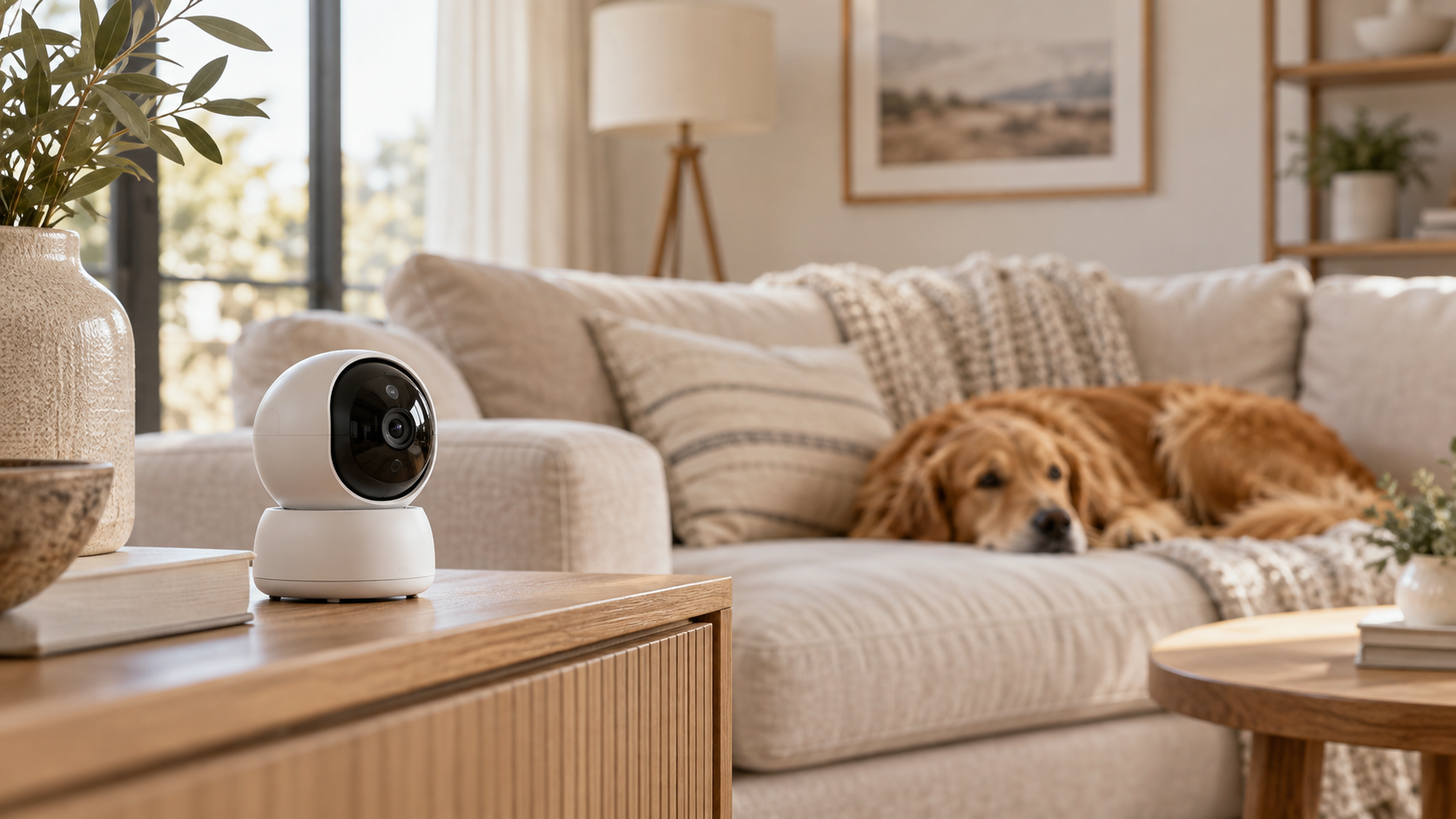
A simple indoor camera, pet camera, laptop webcam, tablet, or old phone can be extremely useful. Position it where you can see your dog's body and, if possible, the main doorway. Then perform a normal departure and observe remotely.
You are not trying to discover how long your dog can endure the situation. You are trying to identify the earliest point at which your dog begins moving from comfortable to concerned.
Subtle early signs of stress may include:
- Suddenly stopping a chew or food toy.
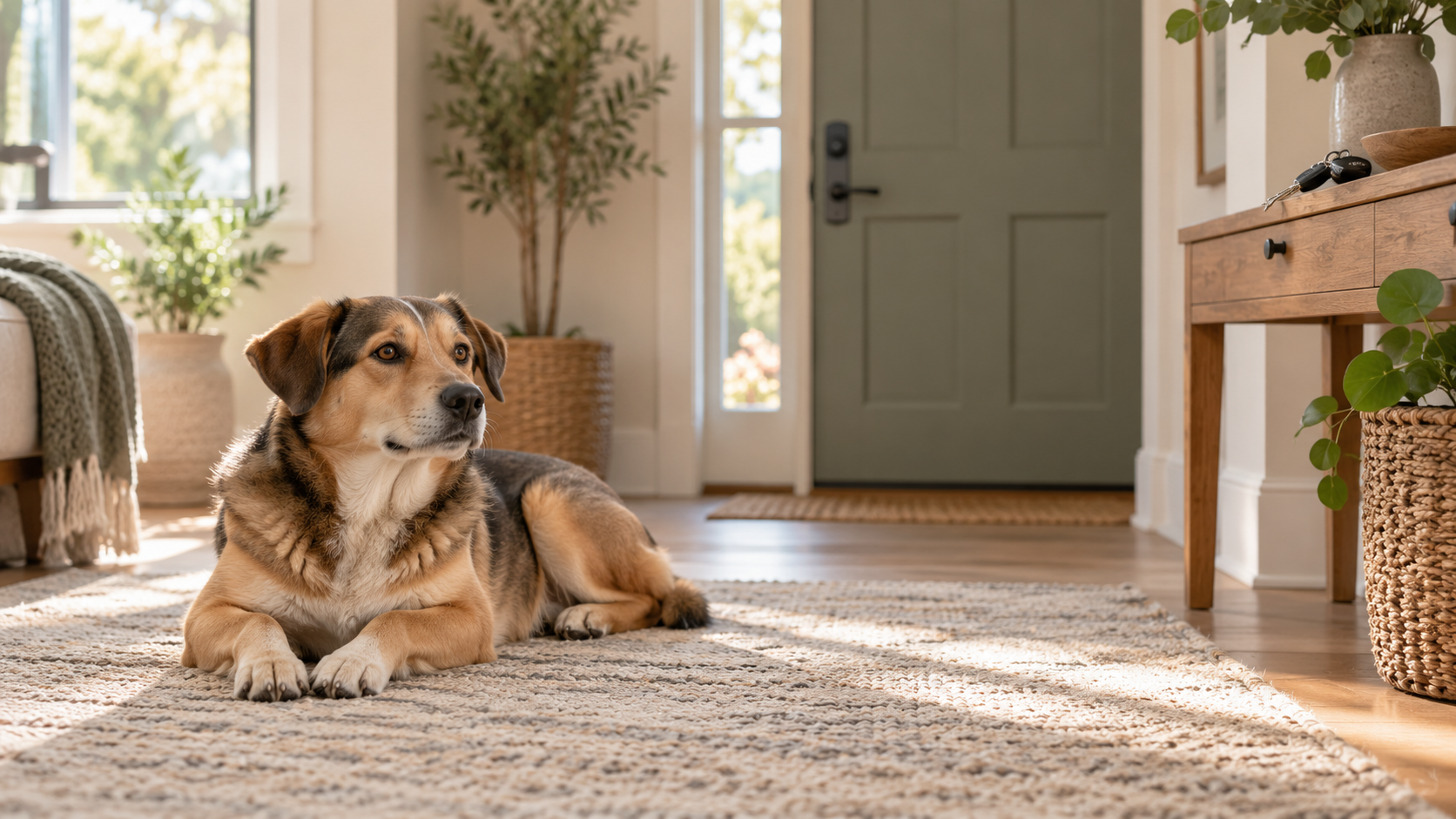
- Staring toward the door after you leave.
- Repeatedly getting up and lying back down.
- Following you more closely as you prepare to leave.
- Lip licking when no food is present.
- Yawning despite not appearing tired.
- Light panting unrelated to heat or exercise.
- Becoming unusually still or watchful.
- Moving repeatedly between windows and doors.
- Soft whining or intermittent vocalization.
- Difficulty settling.
Mild concern is different from full panic. A dog experiencing mild discomfort may briefly look toward the door, reposition, or whine once and then settle again. A dog moving toward panic may show increasing pacing, continuous barking or howling, heavy panting, drooling, frantic scratching, repeated escape attempts, toileting, destruction around exits, or an inability to engage with food.
The point at which stress begins to noticeably build is often called the dog's threshold. In below threshold separation anxiety work, training stays easier than that point whenever possible.
For example, if your dog appears relaxed for 25 seconds but begins pacing at approximately 30 seconds, you would not start practicing 30-second departures. You might begin at 5, 10, or 15 seconds depending on the individual dog.
Some dogs react almost immediately. If your dog panics when you leave within seconds, that does not mean training is impossible. It means the starting point needs to be much smaller.
How to Start Gradual Departure Training
Gradual departure training uses repeated, manageable absences to help your dog become more comfortable with separation. This is closely related to systematic desensitization: exposing the dog to a very low-intensity version of something difficult and increasing that difficulty carefully while trying to keep the dog under threshold.
The process may feel slow at first. That is normal. Building calm repetitions is more useful than repeatedly testing how much distress your dog can tolerate.
Step 1 — Set Up a Calm Baseline
Choose a time when your dog is relatively relaxed. Avoid beginning immediately after something stressful such as a frightening noise, an upsetting visitor, an intense training session, or another event that has left your dog highly aroused.
Meet basic needs first. Give your dog an opportunity to toilet, drink water, move around, sniff, and settle.
Normal physical activity can be helpful, but the goal is not to exhaust the dog into unconsciousness. Separation anxiety is not simply excess energy.
Use the location where your dog is most comfortable. Some dogs relax in a living room or bedroom. Others like access to several rooms. A crate should only be used if the dog genuinely feels safe there. A dog who becomes frantic when confined should not be forced into a crate as a treatment for separation anxiety.
Step 2 — Practice Tiny Absences
Begin with an absence you have good reason to believe your dog can handle.
For one dog, that might mean:
- Walk to the door.
- Open it.
- Step outside.
- Close the door.
- Wait three seconds.
- Come back inside.
For another dog, even closing the door may initially be too difficult. That dog may need to begin with you touching the doorknob, opening the door slightly, or stepping through the doorway and immediately returning.
There is nothing magical about a particular number of seconds. Start where your dog can succeed.
Step 3 — Return Before Distress Escalates
The most important part of early training is returning before your dog progresses into significant distress.
If your dog usually begins whining at 20 seconds, repeatedly practicing 25-second absences is likely too difficult. Instead, you might work with absences such as 5, 8, 10, or 12 seconds while watching your dog's body language.
This is why a camera is so useful. It allows you to base decisions on what your dog is actually doing rather than guessing from outside.
You do not need to sneak back into the house, and you do not need to make your return emotionally cold. Simply return calmly and allow the event to remain ordinary.
Step 4 — Increase Duration Gradually
Once your dog is comfortably handling the current level, begin increasing the duration in small increments.
A common mistake is jumping from something like 30 seconds to five minutes because 30 seconds looked easy. For a dog with significant separation anxiety, that increase may be enormous.
Instead, duration might move from 20 seconds to 25 seconds, then back to 15 seconds, then perhaps 30 seconds. The size of each increase should depend on your dog's response, not on a preset schedule.
If your dog's behavior becomes more worried as duration increases, make the next repetition easier.
Step 5 — Vary Easy and Harder Repetitions
Training does not need to become more difficult every single time.
In fact, mixing easier repetitions with slightly longer ones can prevent the session from feeling like an endless staircase of increasing difficulty.
A session might look like this:
| Practice Stage | Example Absences | What You Are Looking For |
|---|---|---|
| Very early training | 3 sec, 5 sec, 3 sec, 7 sec, 4 sec | Dog remains relaxed and can quickly settle. |
| Early progression | 10 sec, 15 sec, 8 sec, 18 sec, 12 sec | No escalating pacing, vocalizing, or fixation on the exit. |
| Building duration | 25 sec, 40 sec, 20 sec, 50 sec, 30 sec | Dog remains comfortable through both easier and slightly harder repetitions. |
| Longer beginner absences | 1 min, 90 sec, 45 sec, 2 min, 1 min | Behavior remains stable rather than becoming progressively more anxious. |
| Later progression | 3 min, 5 min, 2 min, 6 min, 4 min | Dog can tolerate small increases without clear distress. |
This table is only an example, not a timetable your dog is expected to follow. A dog with severe separation anxiety might need to work at the seconds level for much longer. Another dog may progress faster. If your dog struggles at any stage, reduce the difficulty rather than pushing through.
What to Do About Keys, Shoes, Coats and Other Departure Cues
Many dogs begin becoming anxious before their person actually leaves.
Think about everything you normally do before walking out the door:
- Putting on work shoes.
- Picking up your keys.
- Putting on a coat.
- Grabbing a purse or backpack.
- Turning off lights.
- Checking your phone.
- Walking toward a particular door.
If those events repeatedly predict a difficult separation, they can become anxiety triggers themselves.
You can gently weaken that association by performing departure cues without leaving.
For example, pick up your keys and then sit on the couch. Put on your shoes and make coffee. Put on your coat and watch television for a few minutes. Walk toward the door, touch the handle, and return to what you were doing.
Keep these exercises easy. If simply picking up the keys causes your dog to begin pacing, start with an even less intense version of the cue.
The goal is not to confuse your dog. It is to make these signals less reliable predictors of a frightening absence.
Should You Give Your Dog a Kong or Food Toy?
A stuffed Kong, lickable food toy, chew, or puzzle feeder can be helpful for some dogs. It may create a positive association with alone time and give the dog something relaxing to do as you leave.
You can find additional ideas in our guide to enrichment toys for anxious dogs.
However, food is not a test your dog has to pass.
A dog who happily begins eating but abruptly abandons the food after you leave may be telling you that the separation has become too difficult. Dogs experiencing intense fear often have trouble eating even highly desirable treats.
In that situation, the answer is usually not to find a tastier filling. The training itself may need to become easier.
Food toys are best viewed as a supportive tool, not as a treatment that overrides panic.
What If Your Dog Starts Barking or Panicking?
If barking, whining, pacing, scratching, or another stress behavior begins during a practice absence, do not punish it.
Do not use a bark collar, shock collar, spray collar, leash correction, shouting, intimidation, or physical punishment. These methods do not address the fear driving separation-related distress and may add another source of stress.
Instead, treat the reaction as information: that repetition was too difficult.
Return normally and allow your dog to recover. Then make the next practice substantially easier.
For example, if your dog was comfortable at 40 seconds but began barking during a 60-second absence, you might return to 20 or 30 seconds rather than immediately trying 60 seconds again.
If your dog has already progressed into panic, the priority is ending the distress safely, not waiting outside to prove a point.
This is an important distinction because many owners have heard that returning while a dog is barking will “reward the barking.” Separation anxiety is not simply an obedience exercise. When a dog is panicking, the primary problem is the emotional state underneath the behavior.
Repeatedly allowing intense distress in the hope that the dog will eventually stop is sometimes described as “crying it out” or flooding. That approach is not the goal of evidence-informed desensitization for dog separation anxiety.
What About Times When You Really Have to Leave?
Training is much easier when your dog is not repeatedly experiencing absences that trigger major panic between practice sessions.
When practical, consider temporary management options while you work on training. Depending on your circumstances, that might include:
- A trusted friend or family member staying with your dog.
- A pet sitter.
- Taking the dog with you when appropriate.
- Working from home occasionally if that is available to you.
- Arranging schedules with another household member.
- Using suitable daycare if your dog genuinely enjoys that environment.
These options are not always financially or logistically possible. Do what is realistic for your household. The principle is simply to reduce severe panic episodes when you can while training develops the dog's ability to cope.
How Long Can I Leave My Anxious Dog Alone?
If you are asking, “How long can I leave my anxious dog alone?” there is no single safe number that applies to every dog.
For training purposes, your dog's current comfortable duration matters more than a general rule about how many hours dogs can theoretically stay home.
A dog who begins panicking at two minutes is not ready for a two-hour practice absence simply because another adult dog can comfortably stay home that long.
Use your camera observations to determine what your dog can currently manage. Then build from that level gradually.
For everyday welfare, dogs also need appropriate opportunities for toileting, exercise, social interaction, rest, and enrichment. Age, health, bladder control, temperament, and individual needs all affect how long a dog can reasonably be left.
How Long Does Separation Anxiety Training Take?
There is no reliable fixed timeline for separation anxiety training.
Some dogs improve noticeably in a relatively short period. Others need months of careful work, and progress may not be linear.
You may see stretches where duration increases steadily, followed by days when your dog needs easier practice. Stressful events, illness, environmental changes, unusual noises, changes in routine, or other factors can temporarily lower a dog's tolerance.
Instead of measuring success only by maximum duration, look for broader signs of progress:
- Your dog settles more quickly.
- Departure cues create less concern.
- The dog spends less time watching the doorway.
- Short absences become routine.
- Your dog can eat or rest comfortably during practice.
- Recovery after a difficult repetition becomes easier.
- The dog can tolerate greater variation in your departure routine.
Progress should be judged by the dog's emotional comfort, not by racing toward a particular number of minutes.
Common Mistakes That Slow Progress
Increasing duration too quickly
Large jumps can repeatedly push a dog over threshold. Small successful increases are usually more useful than ambitious attempts followed by panic.
Practicing when the dog is already stressed
A dog who has just experienced an upsetting event may have less capacity for separation practice. On a difficult day, shortening the session or skipping it may be sensible.
Relying only on exercise
Appropriate physical activity and sniffing can support general wellbeing, but separation anxiety is not simply an energy problem. A physically tired dog can still experience panic when left alone.
Forcing crate confinement
Some dogs love their crates. Others experience confinement distress, and panic can become more dangerous when a dog tries to break out.
If your dog claws, bites, bends bars, throws their body against the crate, drools excessively, or shows intense distress while confined, discuss safer management with your veterinarian or a qualified behavior professional.
Waiting for the dog to “cry it out”
Repeatedly exposing a fearful dog to an overwhelming absence is not the same as carefully controlled desensitization. Training should aim to prevent panic, not wait for exhaustion to end it.
Making every repetition harder than the previous one
Progress does not need to be 10 seconds, 20 seconds, 30 seconds, 40 seconds, one minute, two minutes, and so on.
Including easy repetitions can help maintain confidence. Think of the process as a gently uneven path rather than a staircase where every step must go upward.
Ignoring early stress signals
If you wait until your dog is howling or trying to escape before deciding a session was too difficult, you may miss valuable information. Small changes in posture, movement, eating, and attention can tell you much earlier that difficulty is increasing.
When to Get Professional Help
You do not have to manage serious separation-related distress alone.
Contact your veterinarian if your dog shows intense or persistent anxiety, especially if the problem appeared suddenly. Medical conditions can sometimes influence behavior, and your veterinarian can help determine whether additional evaluation is appropriate.
Professional support is especially important when your dog:
- Attempts to escape through doors, windows, crates, or barriers.
- Injures teeth, nails, paws, skin, or other body parts while trying to escape.
- Cannot eat when alone despite normally being highly food motivated.
- Shows extreme drooling, panting, trembling, or frantic pacing.
- Howls or barks continuously during absences.
- Cannot tolerate even very brief separations.
- Has distress severe enough that normal household management is becoming impossible.
- Is not improving despite careful below-threshold training.
A veterinarian may also discuss whether medication is appropriate in more serious cases. Medication is not a substitute for behavior modification, but for some dogs it can be part of a broader treatment plan that makes learning possible.
When choosing training help, look for a professional who uses force-free, reward-based methods and has specific experience with separation-related behavior. Veterinary behaviorists and appropriately qualified behavior professionals can be especially valuable for complicated cases.
Organizations such as the American Veterinary Society of Animal Behavior, the RSPCA, and veterinary behavior professionals emphasize gradual, welfare-centered approaches rather than punishment or forced exposure.
Frequently Asked Questions
Should I ignore my dog before leaving?
No special period of deliberately ignoring your dog is required. You can keep departures calm and predictable without withholding normal affection.
Avoid turning every departure into an intense emotional event, but there is no need to act cold toward your dog. What matters most is whether the separation itself is within a level your dog can cope with.
Should I wait until my dog stops barking before returning?
Not if your dog is barking because they are becoming distressed or panicking.
During separation anxiety training, the ideal situation is to return before significant barking begins. If you misjudge a repetition and your dog starts escalating, return calmly and make the next attempt easier.
Waiting outside through prolonged panic simply to avoid “rewarding” barking can turn the exercise into an overwhelming exposure.
Can another dog cure separation anxiety?
Usually, you should not assume that getting another dog will solve the problem.
Some dogs are distressed specifically by being completely alone and may feel better with another animal present. Others are distressed by separation from a particular person and may still panic even when another dog is in the home.
A second dog is therefore not a reliable treatment for separation anxiety and should only be adopted if you genuinely want and can care for another dog regardless of whether it changes the first dog's behavior.
Does exercise help?
Exercise can support overall wellbeing and may help a dog settle more easily, particularly when it includes appropriate walking, sniffing, play, and enrichment.
However, exercise alone does not teach a frightened dog that separation is safe. Think of it as supportive care rather than a substitute for gradual alone training.
Can puppies develop separation anxiety?
Yes. Puppies can develop distress around being alone, particularly if they have not gradually learned to tolerate short separations.
It is useful to introduce age-appropriate independence early with very short, positive experiences rather than suddenly expecting a puppy who has always had company to remain alone for hours.
Puppies also have practical limitations such as needing more frequent toilet breaks, so training expectations should match their age and development.
What does “below threshold” mean in separation anxiety training?
Below threshold means keeping an exercise easy enough that your dog is still able to cope rather than progressing into significant fear or panic.
The precise signs vary by dog. For one dog, repeatedly standing and staring at the door may indicate that the exercise is becoming difficult. For another, the first meaningful sign may be abandoning a food toy and beginning to pace.
What if my dog can only tolerate five seconds alone?
Then five seconds—or even less—is a valid starting point.
The purpose of early training is not to prove how long your dog can survive without you. It is to accumulate successful experiences. A dog who calmly completes repeated three- to five-second separations is learning more useful information than a dog repeatedly pushed into panic at 30 seconds.
Can I practice several times a day?
Possibly, but more training is not automatically better. Short, successful sessions are usually preferable to long sessions that leave your dog increasingly worried.
Watch how your dog responds between repetitions and sessions. If stress is building rather than decreasing, reduce the difficulty, shorten the session, or give your dog more recovery time.
Building Alone Time Without Building Fear
Learning how to leave a dog alone with separation anxiety is less about teaching obedience and more about helping the dog feel safe during separation.
Start with what your dog can genuinely handle today. Use a camera. Watch for early stress signals. Practice tiny absences. Return before anxiety escalates, and increase duration gradually rather than testing your dog's limits.
Some days will move forward faster than others. An easier session after a difficult day is not failure. It is an adjustment based on the information your dog is giving you.
Most importantly, do not punish fear and do not deliberately make your dog endure panic. Calm, gradual, below-threshold practice gives your dog repeated opportunities to learn a different pattern: you leave, they remain safe, and you come back.
For dogs with severe distress, escape attempts, self-injury, inability to eat, or intense panic, involve your veterinarian and a qualified, force-free behavior professional. With an individualized plan and realistic expectations, gradual progress can be built one manageable absence at a time.