Separation anxiety in puppies is not the same as every whine, bark, or protest that happens when a young dog is left alone. Puppies are social, immature, and still learning that short separations are safe. Some crying during adjustment can be normal, especially in a newly adopted puppy. However, intense or escalating distress—such as frantic escape attempts, persistent screaming, heavy panting, drooling, or an inability to settle—deserves closer attention. Gentle, gradual puppy alone training can help teach independence without forcing a puppy to “cry it out.”
The goal is not to make a puppy completely independent overnight. It is to build many small experiences in which separation feels predictable, manageable, and safe.
Is It Normal for a Puppy to Cry When Left Alone?
Yes, some crying can be normal when a puppy is learning to be alone.
Young puppies have usually spent their early lives sleeping and interacting closely with their mother, littermates, breeders, foster families, or other people. Moving into a new home changes almost everything at once: smells, sounds, sleeping arrangements, routines, people, and social contact.
A puppy who cries when left alone may simply be expressing uncertainty, frustration, or a desire to regain contact.
What matters is how intense the reaction is, how long it lasts, and whether the puppy is able to recover.
A puppy who whines briefly when you step behind a baby gate, then begins chewing a toy and eventually falls asleep, is showing a very different pattern from a puppy who becomes increasingly frantic, throws their body against the barrier, pants heavily, refuses food, and cannot settle.
It is important not to dismiss significant distress simply because the dog is young. Puppies need opportunities to learn independence, but learning should happen gradually rather than through repeated overwhelming experiences.
What Separation Anxiety Can Look Like in Puppies
Puppy separation anxiety or other forms of separation-related distress can involve more than vocalization.
Possible signs include:
- Persistent barking, whining, howling, or high-pitched crying after separation.
- Frantic scratching at doors, gates, crates, or barriers.
- Repeated attempts to escape.
- Pacing without being able to settle.
- Heavy panting when the puppy is not hot or recently exercised.
- Excessive drooling.
- Ignoring normally exciting food or treats after you leave.
- Repeatedly checking the door or area where you disappeared.
- Becoming extremely distressed when you prepare to leave.
- Following you constantly from room to room.
- Becoming distressed even during very short separations inside the home.
- Toileting during absences despite being capable of remaining clean for that period under other circumstances.
No single behavior proves that a puppy has separation anxiety. For example, young puppies commonly have toileting accidents because bladder control is still developing, and puppies may chew household objects simply because chewing is a normal developmental behavior.
Look at the entire pattern rather than diagnosing from one sign.
If you want to compare your puppy's behavior with common separation-related patterns, see our guide to the signs of separation anxiety in dogs.
Normal Puppy Protest vs Significant Distress
Some puppies complain briefly when access to a person is interrupted. That does not automatically mean they are experiencing severe anxiety.
The following comparison can help you think about what you are observing:
| What You Observe | More Consistent With Mild Protest or Adjustment | More Concerning for Significant Distress |
|---|---|---|
| Vocalization | Brief whining or barking that decreases | Persistent, escalating crying, howling, or screaming |
| Movement | Checks the barrier, then explores or rests | Continuous pacing or frantic movement |
| Food | Can take treats, chew, or eat | Refuses normally valuable food during separation |
| Body language | Gradually becomes loose and relaxed | Heavy panting, trembling, drooling, or rigid vigilance |
| Barrier behavior | Brief pawing, then disengages | Repeated biting, climbing, scratching, or escape attempts |
| Recovery | Settles within a manageable period | Distress continues or intensifies until the person returns |
| Short practice sessions | Improves with repetition | Becomes more distressed despite very short separations |
This table is a guide, not a diagnostic tool. Puppies vary significantly in temperament, developmental stage, previous experience, and confidence.
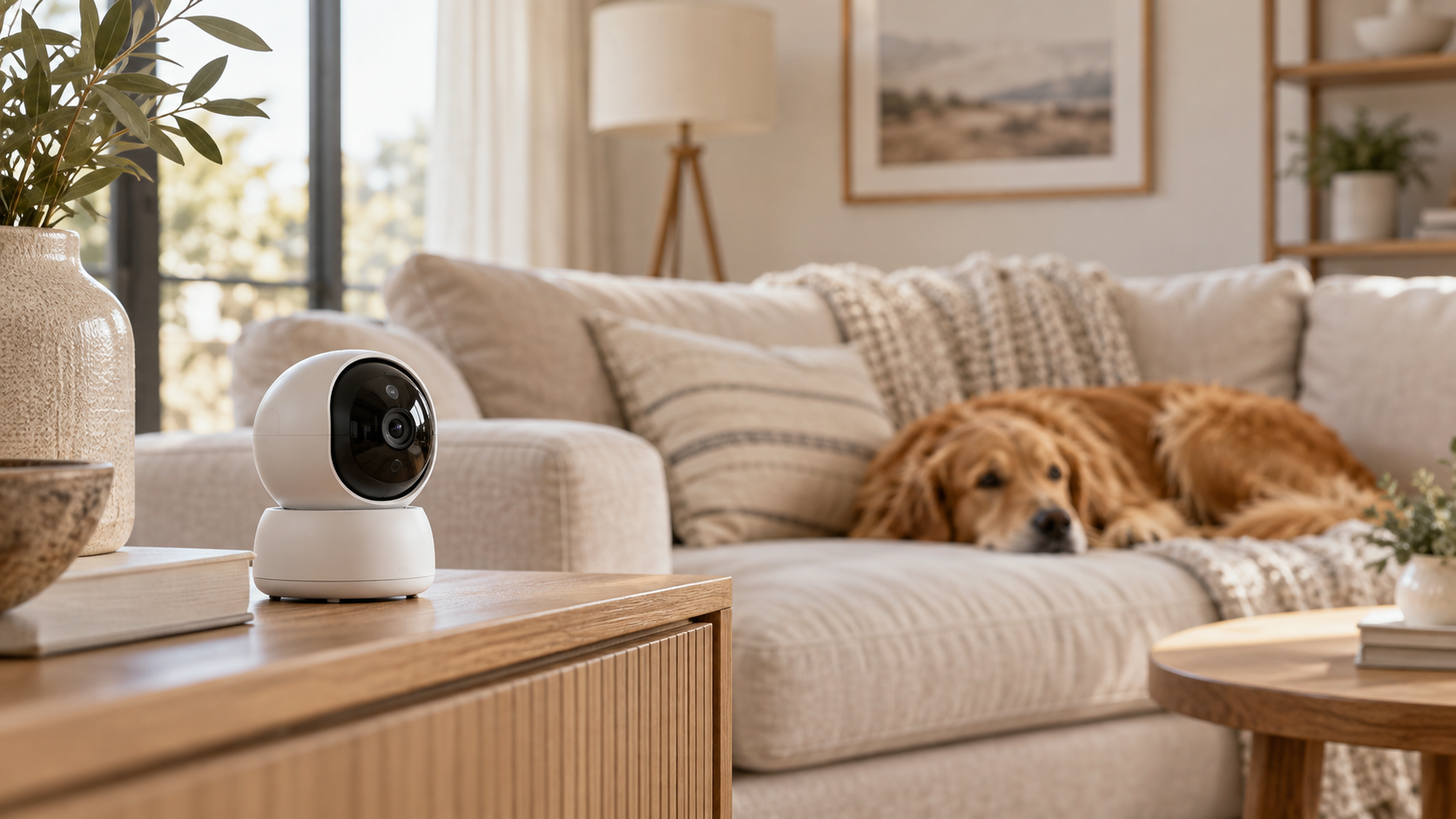
Video monitoring can provide much better information than listening from another room because it lets you see whether the puppy is settling or becoming increasingly distressed.
How to Teach a Puppy to Feel Safe Alone
When learning how to leave a puppy alone, think in terms of small, repeatable successes.
You do not need to begin by leaving the house for 30 minutes. For a very young or uncertain puppy, independence training may start with only a few feet of distance.
Begin While You Are Still Nearby
Teach your puppy that being physically separated from you does not always mean being completely abandoned.
For example, you might give your puppy a comfortable resting area with a toy or chew while you sit several feet away.
You can also practice:
- Your puppy relaxing on a bed while you move around the room.
- Your puppy staying behind a baby gate while you remain visible.
- Your puppy playing independently while you sit nearby.
- Brief periods when you do not continuously interact with the puppy.
This is especially useful if your puppy follows you everywhere.
Following is normal social behavior for many puppies, but they can also learn that they do not need to accompany you every second of the day.
Reward calm independent behavior when it happens naturally. If your puppy lies on a bed while you move around the kitchen, quietly reinforce that choice rather than always calling the puppy back to you.
Practice Tiny Separations
Once your puppy is comfortable with small amounts of distance, introduce extremely brief separations.
A beginner progression could look like this:
- Step behind a doorway for one second.
- Return calmly.
- Repeat several easy times.
- Step away for two or three seconds.
- Return before the puppy becomes significantly distressed.
- Mix shorter and slightly longer repetitions.
If three seconds causes immediate panic, three seconds is currently too difficult.
You might instead practice simply moving toward the doorway and coming back.
The principle is simple: start below the level that triggers significant distress and build gradually.
Build Duration Before Distance Carefully
Duration and distance are both forms of difficulty.
If your puppy can remain relaxed while you stand five feet away for 30 seconds, disappearing completely for the same 30 seconds may still be harder.
Change one variable at a time when possible.
For example:
- Stay visible but increase duration slightly.
- Then reduce duration while briefly moving out of sight.
- Return to an easier repetition after a harder one.
- Increase difficulty only while your puppy continues to cope.
A progression does not need to become harder every single time.
You might practice five seconds, eight seconds, four seconds, ten seconds, and six seconds rather than continuously increasing duration.
This prevents every repetition from predicting a more difficult separation.
Introduce Everyday Departure Cues
Puppies quickly notice patterns.
Shoes, keys, coats, backpacks, purses, and the sound of a particular door can all become predictors that someone is leaving.
You can make these cues ordinary by practicing them without always leaving.
For example:
- Pick up your keys and sit back down.
- Put on your shoes and prepare breakfast.
- Open the front door, close it, and remain home.
- Pick up your work bag and move it somewhere else.
Keep these exercises calm and low-key.
If your puppy is already becoming highly worried at the sight of your keys or shoes, make the exercise easier rather than repeatedly triggering a strong response.
Use Food and Enrichment Appropriately
Food toys, safe chews, licking activities, and simple enrichment can make independent time more enjoyable.
You can explore ideas in our guide to enrichment toys for anxious dogs.
For example, you might offer part of your puppy's normal meal in an appropriate food toy while you sit nearby, then gradually introduce brief periods of distance.
But food should not be used to cover up overwhelming distress.
If your puppy normally loves a food toy but refuses it as soon as you leave, repeatedly offering richer treats may not solve the underlying problem.
Instead, make the separation easier.
How Long Can a Puppy Be Left Alone?
There is no single behavioral maximum that applies to every puppy.
When asking how long a puppy can be left alone, you need to consider at least two separate questions:
- How long can the puppy physically wait before needing to toilet?
- How long can the puppy emotionally remain comfortable without becoming distressed?
Those are not always the same.
A puppy may physically be capable of waiting a certain amount of time to urinate but emotionally become distressed after only a few minutes of isolation.
Another puppy may feel perfectly relaxed alone but still need frequent toilet opportunities because of age and bladder development.
Factors that influence appropriate alone time include:
- Age.
- Individual bladder control.
- Previous alone-time experience.
- Sleep schedule.
- Feeding and drinking schedule.
- Health.
- Temperament.
- Current level of independence.
- Whether the puppy is awake or sleeping.
- The environment in which the puppy is left.
Do not assume that because your puppy can physically remain clean for a certain period, they are emotionally ready to spend that entire period alone.
Likewise, do not extend alone time simply because a puppy eventually stops crying. Use a camera whenever possible to see whether the puppy has genuinely settled.
Common Mistakes
Sudden long absences
A puppy who has never been alone should not be expected to comfortably handle a major separation simply because the household schedule suddenly requires it.
If possible, build independence gradually before long absences become necessary.
Forcing the puppy to cry
There is an important difference between a brief complaint and escalating distress.
Repeatedly allowing a frightened puppy to become overwhelmed in the hope that they will eventually “cry it out” is not the goal of force-free alone-time training.
If your puppy is escalating rather than settling, reduce the difficulty.
Only practicing when you really need to leave
If every separation happens when you have an appointment, work shift, or errand, you have little control over how long the absence lasts.
Training sessions should also happen when you have time to return after a few seconds or minutes.
This gives you the freedom to match the exercise to your puppy's current ability.
Making the crate the only place the puppy is ever separated
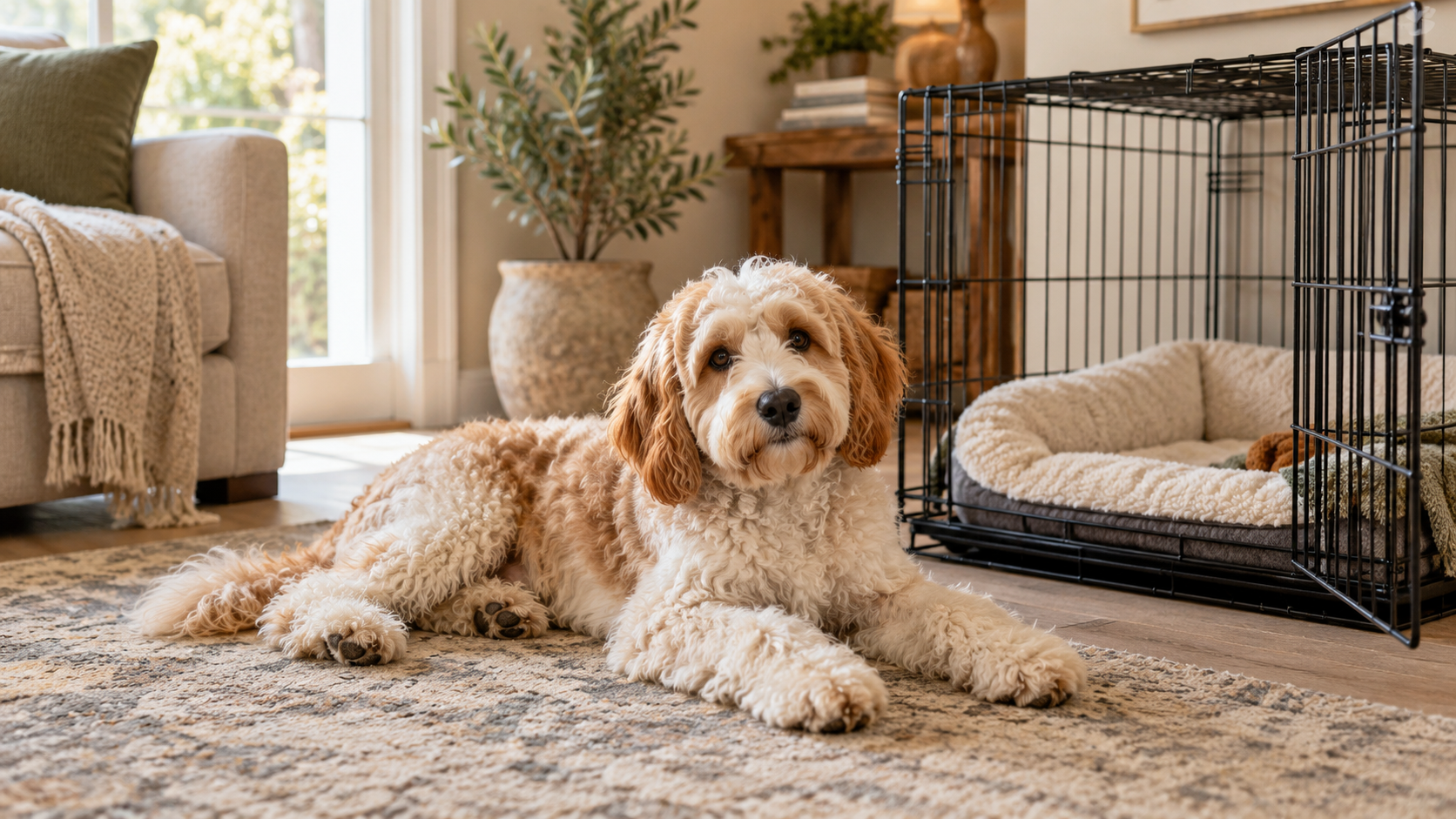
A crate can be a comfortable resting area for puppies who have been positively introduced to it, but crate training and independence training are not exactly the same thing.
A puppy can learn to sleep happily in a crate while still struggling when people leave the home.
Similarly, some puppies find tight confinement more difficult than being alone in a larger safe area.
When appropriate, teach independence in several safe contexts rather than making every separation happen behind the same closed crate door.
Punishing vocalization
Do not use shouting, startling, spray collars, shock collars, intimidation, physical corrections, or dominance-based techniques to stop crying.
Vocalization is communication.
Your job is to determine whether the puppy is mildly protesting, needs something practical such as a toilet break, or is becoming genuinely distressed.
Punishment may suppress some behavior without teaching the puppy to feel safer.
Puppies Raised by Work-From-Home Owners
Working from home can be wonderful for raising a puppy, but constant availability can accidentally mean the puppy gets very little practice being independent.
If your puppy spends almost every waking moment beside your desk, start building small amounts of separation before you actually need them.
Useful ideas include:
- Give your puppy a safe resting area a few feet from your workspace.
- Encourage occasional naps in another appropriate area.
- Walk into another room for a few seconds while your puppy is relaxed.
- Use short baby-gate separations while you remain visible.
- Let the puppy enjoy safe enrichment without continuous interaction from you.
- Practice brief departures from the house even on days when you have nowhere to go.
- Alternate time together with short periods of age-appropriate independence.
The aim is not to ignore your puppy for large parts of the day.
It is to prevent your physical presence from becoming a requirement for every nap, meal, chew, and moment of relaxation.
If your puppy follows you into every room, start with very easy exercises. Closing a door for ten minutes may be far too large a first step. Walking through a doorway and immediately returning may be enough.
When to Ask for Professional Help
Some puppies need more support than a general alone-training plan can provide.
Contact your veterinarian or a qualified, reward-based behavior professional if your puppy:
- Cannot tolerate even extremely brief separations.
- Shows intense panic almost immediately after you leave.
- Repeatedly tries to escape crates, rooms, windows, or barriers.
- Damages teeth, nails, paws, or other body parts while trying to escape.
- Shows heavy panting, excessive drooling, trembling, or other intense stress responses.
- Refuses food during separation despite being normally food motivated.
- Appears increasingly distressed despite gradual training.
- Cannot settle when separated even while you remain nearby.
- Has a sudden major behavior change.
A veterinarian can also help rule out medical issues that may affect behavior, sleep, toileting, appetite, or comfort.
If your puppy is injuring themselves during escape attempts or showing severe panic, do not repeatedly recreate the situation simply to see whether they eventually adjust.
Early professional guidance can help you create a safer, more individualized plan.
Frequently Asked Questions
Should I ignore my puppy when they cry at night?
Not automatically.
Young puppies may cry at night because they are frightened, need to toilet, are uncomfortable, or are struggling with the abrupt transition from sleeping with littermates to sleeping alone.
A brief vocalization that quickly stops is different from escalating distress.
Nighttime independence can be built gradually. Some families begin with the puppy sleeping close enough to feel secure and gradually increase distance as the puppy adapts.
You do not need to make nighttime frightening in order to teach independence.
Should I use a crate for puppy alone training?
You can use a crate if your puppy has been introduced to it positively and genuinely feels comfortable there.
The crate should not be used as a place where the puppy is forced to endure panic.
A puppy who voluntarily enters, rests, chews, and sleeps in a crate is giving very different feedback from one who bites the bars, screams, pants heavily, or desperately tries to escape.
Crate comfort and separation comfort should be evaluated separately.
Should my puppy sleep in another room to teach independence?
Not necessarily.
Sleeping separately is only one form of independence, and forcing a frightened young puppy into a distant room is not required for healthy development.
You can teach independence during daytime activities through short, manageable separations even if your puppy initially sleeps near you at night.
If you eventually want the puppy to sleep elsewhere, transition gradually rather than treating the change as a test of willpower.
Is daycare good for puppies with separation anxiety?
Daycare can provide supervision and social activity for some puppies, but it is not a treatment for separation anxiety.
Not every puppy enjoys a busy daycare environment, and suitability depends on temperament, vaccination status, health, the facility, supervision quality, and play style.
Even if daycare prevents a puppy from being alone on certain days, the puppy may still need gradual independence training at home.
Will getting a second dog prevent separation anxiety?
Not reliably.
Some puppies enjoy canine companionship, but another dog does not automatically teach a puppy to feel comfortable when humans leave.
A puppy can become distressed by separation from a particular person even when another dog is present.
Do not adopt a second dog solely as a treatment for separation-related behavior.
My puppy follows me everywhere. Is that separation anxiety?
Not necessarily.
Puppies commonly follow people because they are social, curious, learning household routines, and looking for safety or interaction.
Following becomes more relevant when the puppy also struggles significantly whenever access to the person is interrupted.
Look at what happens when you move behind a gate, close a door briefly, or leave the home. A puppy who can eventually settle is showing a different pattern from one who immediately becomes frantic.
How do I leave my puppy alone for the first time?
Make the first experience much easier than a real-life long absence.
Meet your puppy's toileting and basic needs first, provide a safe environment, and begin with a separation short enough that the puppy is likely to remain comfortable.
That might mean only a few seconds.
Use a camera if possible, return calmly, and repeat easy successes before increasing duration.
Should I make a big fuss when I come home?
You do not need to ignore your puppy, but arrivals can remain calm and predictable.
Offer normal affection without turning every reunion into an extremely intense event.
More importantly, focus on making the absence itself manageable rather than trying to control your puppy's emotions by withholding attention before or after leaving.
Building Healthy Independence One Small Step at a Time
Separation anxiety in puppies is best understood by looking at patterns rather than assuming every cry means a serious disorder—or assuming every distressed puppy simply needs to toughen up.
Young puppies are still developing emotionally and learning how their new world works. Some protest is common, but escalating panic, escape behavior, inability to settle, or severe distress deserves attention.
The most useful prevention strategy is gentle, gradual puppy alone training: begin while you are nearby, introduce tiny separations, increase difficulty slowly, make departure cues ordinary, and use food or enrichment as supportive tools rather than distractions from panic.
Do not measure success by how long your puppy can be forced to remain alone. Measure it by whether your puppy is learning to feel safe and recover comfortably.
With consistent practice, many puppies can gradually learn an important life skill: sometimes their people leave, being alone can still feel safe, and their people come back.