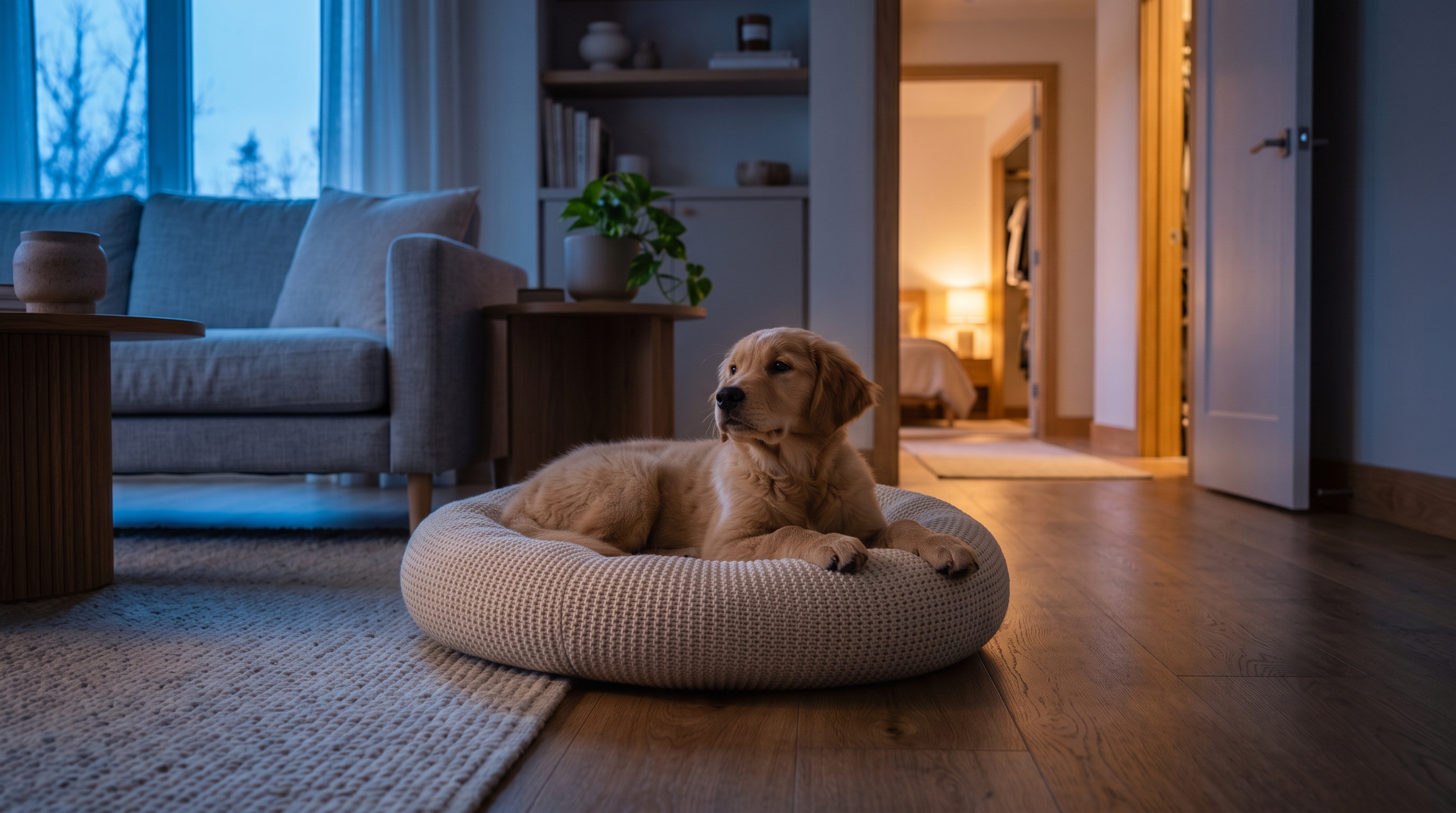
Dog separation anxiety at night can happen, but nighttime restlessness is not automatically separation anxiety. A dog who cries, follows you, paces, barks, or refuses to sleep alone may be distressed by separation, but similar behavior can also be caused by environmental noises, toileting needs, pain, illness, age-related changes, fear, or a disrupted routine. The most useful first step is to look at when the behavior occurs, what happens when you move away, whether your dog can settle near you, and whether the problem appeared suddenly.
If your dog is comfortable during the day but becomes unsettled only at night, avoid assuming the problem is behavioral. Nighttime changes can sometimes provide important clues about your dog's physical comfort, environment, or changing needs.
Can Dogs Have Separation Anxiety at Night?
Yes. Some dogs become distressed when separated from a person at bedtime, even if that separation happens inside the same home.
For example, a dog may sleep comfortably beside the owner's bed but begin whining, pacing, scratching at the bedroom door, or barking when asked to sleep alone in another room.
Other dogs are comfortable sleeping separately but become distressed when the owner actually leaves the house at night.
Separation-related distress is more likely when the dog's behavior is closely tied to losing access to a particular person.
However, dog anxiety at night has many possible causes. A dog who wakes at 2:00 a.m. and wanders through the house is not necessarily experiencing separation anxiety, especially if the behavior also occurs while the owner is nearby.
To better understand whether your dog's behavior fits a broader separation-related pattern, see our guide to the signs of separation anxiety in dogs.
Signs Separation May Be Part of the Problem
Separation may be contributing to nighttime distress when your dog's behavior reliably changes depending on whether they can access you.
Possible clues include:
- Your dog settles quickly when allowed to sleep near you but becomes distressed when separated.
- Your dog follows you closely as bedtime approaches.
- Your dog waits outside your bedroom door and cannot settle.
- Your dog scratches or paws at the barrier separating you.
- Your dog whines, barks, or howls primarily after you move away.
- Your dog repeatedly gets up to search for you.
- Your dog becomes distressed when you close a bedroom door.
- Your dog seems comfortable until you leave the house.
- Your dog cannot settle despite having a familiar bed, water, and a comfortable environment.
- The intensity decreases rapidly once access to you is restored.
These patterns can suggest that separation is relevant, but no single sign confirms a diagnosis.
If dog barking at night anxiety is one of your main concerns, it is also worth considering what the barking is responding to. Barking may be triggered by fear, outside sounds, territorial alerting, frustration, discomfort, or separation. Our guide to excessive dog barking explains why identifying the trigger matters.
Other Reasons a Dog May Be Restless at Night
A dog pacing at night may be responding to something other than separation.
Environmental noises
Dogs can hear sounds that people barely notice. Nighttime may make certain noises more noticeable because the home is otherwise quiet.
Potential triggers include:
- Cars or motorcycles.
- People in hallways.
- Elevators.
- Neighboring dogs.
- Wildlife outside.
- Wind or storms.
- Heating or cooling systems.
- Building noises.
A dog may repeatedly wake, listen, bark, or move around even though separation is not the primary issue.
Toileting needs
A dog who wakes and paces may need to urinate or defecate.
This can be particularly relevant for puppies, senior dogs, dogs whose feeding or drinking schedule has changed, or dogs experiencing a health problem.
Pain or physical discomfort
Some dogs have more difficulty getting comfortable at night because of pain or stiffness.
You might notice:
- Repeatedly changing sleeping position.
- Getting up and lying down again.
- Difficulty climbing onto a bed.
- Reluctance to use stairs.
- Restlessness after previously sleeping normally.
These signs deserve veterinary attention, especially when they are new.
Age-related changes
Older dogs can experience changes in sleep patterns, vision, hearing, orientation, mobility, and cognition.
A senior dog who suddenly begins waking, wandering, vocalizing, or appearing confused at night should not automatically be labeled as having separation anxiety.
Veterinary evaluation is appropriate because age-related behavior changes can have multiple medical or neurological explanations.
Fear
A dog may become frightened by darkness, storms, unfamiliar sounds, a new sleeping location, or a recent stressful event.
If the dog's distress occurs whether or not you are nearby, the trigger may be environmental rather than separation itself.
Routine disruption
Dogs often adapt to predictable household routines.
Nighttime behavior may change after:
- Moving to a new home.
- A family member leaving or joining the household.
- A new baby arriving.
- A change in work schedule.
- Travel.
- A recent boarding stay.
- A major shift in sleeping arrangements.
A temporary adjustment period may follow these changes.
Why Sudden Nighttime Anxiety Deserves Attention
A dog suddenly anxious at night deserves a closer look, particularly if the dog previously slept normally.
Behavior that changes abruptly can sometimes reflect discomfort or illness rather than a training problem.
Contact your veterinarian if nighttime restlessness appears suddenly or is accompanied by:
- Changes in appetite.
- Vomiting or diarrhea.
- Increased or decreased drinking.
- More frequent urination.
- Difficulty getting comfortable.
- Stiffness or limping.
- Weakness.
- Lethargy.
- Confusion or disorientation.
- Changes in hearing or vision.
- Unexpected weight loss.
- New sensitivity to touch.
- Other changes in normal behavior.
This is especially important for older dogs. New nighttime pacing, vocalization, wakefulness, or confusion in a senior dog should be discussed with a veterinarian rather than assumed to be separation anxiety.
How to Help a Dog Feel Safer at Night
Once medical concerns have been considered, focus on making nighttime predictable and comfortable.
Keep a consistent evening routine
A calm sequence can make bedtime easier to understand.
For example:
- Provide an appropriate evening toilet break.
- Allow some calm sniffing or gentle activity.
- Reduce stimulating play close to bedtime if it makes your dog more alert.
- Prepare the sleeping area.
- Dim lights and reduce household activity.
- Follow roughly the same bedtime routine each night.
Consistency does not guarantee that anxiety will disappear, but predictability can help reduce uncertainty.
Reconsider the sleeping location
If your dog suddenly struggles after being moved to a distant room, the change may simply have been too large.
You can temporarily move the bed closer and gradually increase distance later.
Likewise, if the dog is disturbed by street noise near a window, moving the bed to a quieter part of the home may help.
Use environmental management
Small changes can reduce nighttime triggers.
Depending on your dog, consider:
- Closing curtains or blinds.
- Moving the bed away from windows or exterior doors.
- Reducing hallway noise.
- Keeping the room at a comfortable temperature.
- Providing familiar bedding.
- Using a dim night-light if darkness appears to increase uncertainty.
Consider white noise
White noise, a fan, or another consistent low-level background sound may help some dogs by reducing the contrast between silence and unpredictable environmental noises.
Keep the volume comfortable and observe your dog's response. Not every dog finds the same sounds relaxing.
Offer comfort without turning the situation into a battle
Comforting a frightened dog does not teach them to be afraid.
You can respond calmly, help your dog settle, and then work on independence gradually.
The goal is not to create dependence on constant reassurance. It is to avoid forcing an overwhelmed dog through a situation they cannot currently handle.
How to Gradually Teach Your Dog to Sleep Farther Away
If your dog won't sleep without you and your goal is eventually to have them sleep farther away, make the change gradually.
Do not begin by abruptly moving the dog from beside your bed to the opposite end of the house.
A gentle progression could look like this:
- Start with the dog's bed in a location where they already sleep comfortably.
- Reward calm settling in that spot.
- After several comfortable nights, move the bed a small distance farther away.
- Keep the new distance easy enough that your dog can still relax.
- If your dog remains comfortable, gradually increase the distance over time.
- Later, practice having the bed just outside the bedroom if that is your goal.
- Only introduce a closed door once the dog is comfortable with the previous steps.
You can also practice daytime versions of the same skill.
For example, ask your dog to relax on a bed several feet away while you read, work, or watch television. Calm independence during the day can make nighttime distance less unfamiliar.
If your dog becomes distressed after a particular change, return to an easier step rather than forcing the new distance.
A successful progression might involve moving forward, then slightly backward, then forward again. There is no requirement for every night to be harder than the previous one.
Should You Let Your Dog Sleep in Your Bedroom?
Allowing a dog to sleep in your bedroom is a household preference, not automatically a behavioral mistake.
Sleeping near you does not by itself cause separation anxiety.
Potential benefits may include:
- The dog may settle more easily.
- You may notice nighttime health or toileting needs sooner.
- The arrangement may reduce distress in a newly adopted or recently relocated dog.
- It can be convenient during gradual adjustment.
Possible drawbacks may include:
- Your dog may wake you during normal movement.
- You may prefer a dog-free sleeping space.
- Another sleeping arrangement may eventually be necessary because of children, allergies, travel, or household changes.
- A dog who has never practiced sleeping elsewhere may find a sudden future change more difficult.
If sleeping in the bedroom works for your household, there is no need to change it simply out of fear that proximity will “cause” separation anxiety.
If you prefer your dog to sleep elsewhere, teach that skill gradually.
What Not to Do
Nighttime distress can be frustrating, particularly when it interrupts your sleep. But punishment and forced isolation can make fear worse.
Avoid:
- Shouting at your dog for crying or barking.
- Using shock collars, bark collars, spray collars, or other aversive devices.
- Physically forcing the dog into a sleeping area.
- Using intimidation or dominance-based techniques.
- Moving a distressed dog abruptly from beside you to complete isolation.
- Repeatedly exposing the dog to intense distress in the hope they will “get used to it.”
- Assuming every nighttime problem is behavioral without considering health.
If your dog is vocalizing, ask why before deciding how to respond.
A dog who briefly complains and settles is different from a dog who is escalating into panic.
When to Contact a Vet or Behavior Professional
Veterinary advice is appropriate when nighttime behavior changes suddenly, particularly if your dog is older or shows any additional health changes.
Contact your veterinarian if your dog develops:
- Sudden nighttime pacing or agitation.
- Persistent inability to sleep.
- Changes in appetite or thirst.
- Changes in urination or bowel movements.
- Signs of pain or stiffness.
- Confusion or disorientation.
- New nighttime vocalization.
- Significant changes in activity or personality.
A qualified, reward-based behavior professional may also be helpful if the problem clearly appears connected to separation and gradual training is not improving it.
Seek professional support sooner if your dog:
- Panics whenever separated from you.
- Tries frantically to escape rooms or crates.
- Damages teeth, nails, paws, or other body parts while trying to reach you.
- Shows intense drooling, panting, or sustained vocalization.
- Cannot tolerate even very brief nighttime separation.
- Has distress that is significantly affecting daily life.
If you are uncertain whether the behavior represents anxiety or something more ordinary, comparing separation anxiety vs. boredom in dogs can help you think about the wider behavioral pattern.
Frequently Asked Questions
Why has my dog suddenly started following me at night?
A dog may begin following you at night because they are frightened, uncomfortable, need to toilet, have experienced a change in routine, or are seeking reassurance.
Sudden clinginess is not automatically separation anxiety.
If the behavior is new—especially in an older dog—or occurs with pacing, confusion, appetite changes, pain, increased drinking, toileting changes, or other unusual behavior, contact your veterinarian.
Should I ignore nighttime whining?
Not automatically.
First consider what the whining may mean.
Your dog may need to toilet, may be uncomfortable, may have heard something frightening, or may be struggling with separation.
A brief whine that quickly resolves is different from sustained or escalating distress.
If whining consistently occurs after you increase sleeping distance, make the transition easier rather than relying on a cry-it-out approach.
Can older dogs develop nighttime anxiety?
Yes. Older dogs can become more restless or anxious at night for a variety of reasons.
Changes in hearing, vision, mobility, physical comfort, sleep patterns, and cognitive function can all influence nighttime behavior.
Because these changes can have medical causes, new nighttime anxiety in a senior dog should be discussed with a veterinarian.
Does sleeping with my dog cause separation anxiety?
Sleeping near your dog does not by itself cause separation anxiety.
Many dogs sleep in the same bedroom as their owners and still tolerate daytime separation comfortably.
What matters more is whether the dog has opportunities to develop age-appropriate independence and whether they can cope when separation actually occurs.
If you want your dog to sleep elsewhere, gradual training is generally more appropriate than suddenly removing all nighttime contact.
Will a crate help my dog sleep alone?
It may help if your dog already feels safe and relaxed in the crate.
A crate should not be used to force a frightened dog to remain isolated.
If your dog voluntarily enters the crate, settles, sleeps comfortably, and shows relaxed body language, it may be an appropriate sleeping location.
If your dog pants heavily, bites the bars, scratches frantically, vocalizes continuously, drools excessively, or attempts to escape, confinement may be increasing distress.
Why does my dog bark only after I go to bed?
There are several possibilities.
Your dog may be responding to outside sounds, becoming frustrated by a barrier, seeking access to you, needing to toilet, or reacting to another environmental change.
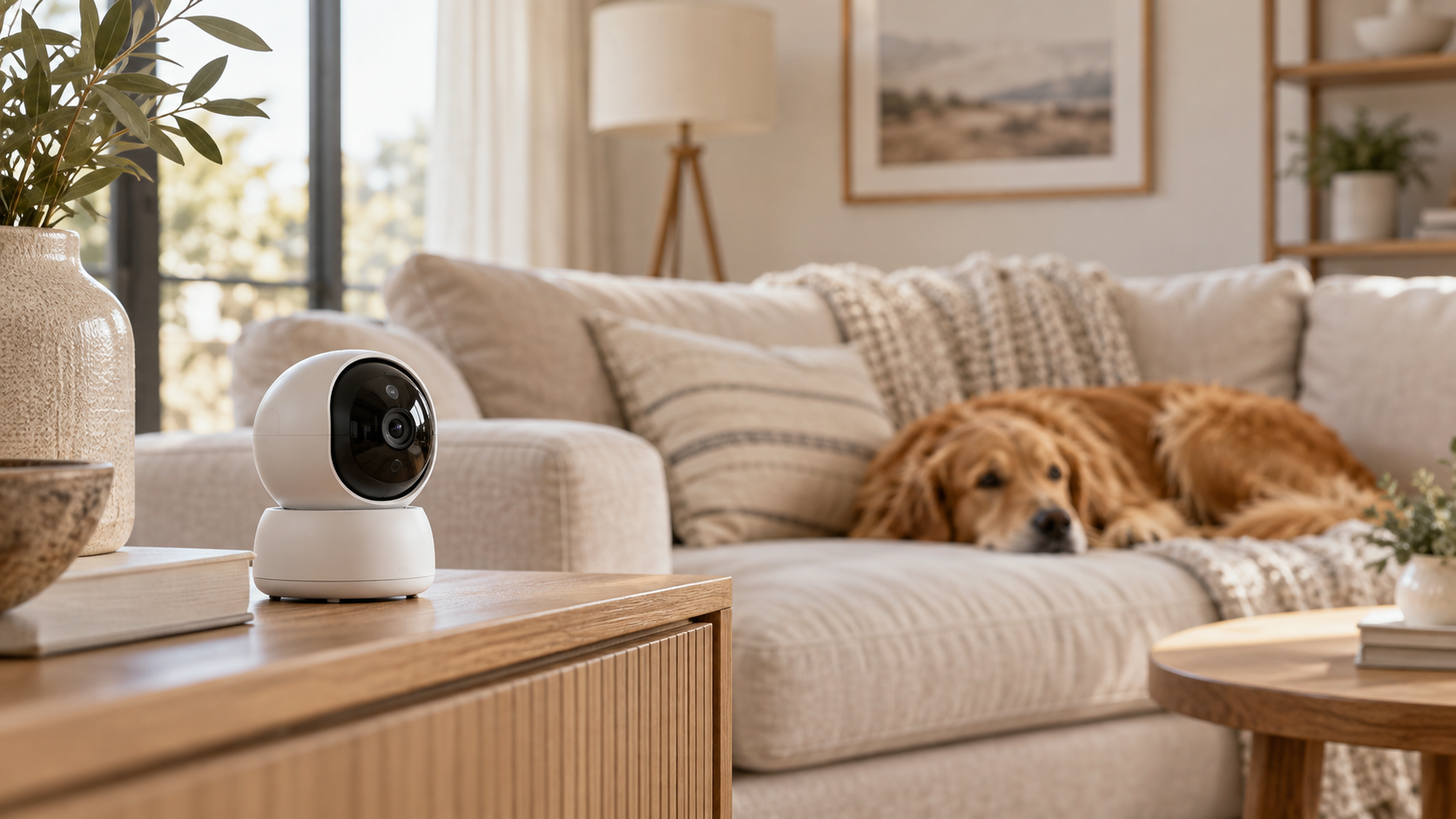
A camera can help show whether the dog is standing at your bedroom door, watching a window, reacting to sounds, pacing through the home, or settling between barking episodes.
Those details can help identify what the barking is actually connected to.
Should I move my dog's bed closer if they are anxious?
That can be a reasonable temporary step.
If moving the bed closer allows your dog to relax, you can later increase distance gradually rather than insisting on a sleeping location that currently causes significant distress.
Making the exercise easier is not failure. It can create a more workable starting point for training.
Look for the Cause Before Trying to Change the Behavior
Dog separation anxiety at night is only one possible explanation for crying, barking, following, or pacing after dark.
The most important question is not simply whether your dog wants to be near you. It is why your dog is having difficulty settling.
Look at the pattern. Does the behavior begin when you move away? Does your dog settle immediately when allowed near you? Are outside noises involved? Does the dog need to toilet? Is the behavior new? Are there signs of discomfort, confusion, or other health changes?
If separation appears to be part of the problem, build independence gradually. Start from a sleeping distance your dog can handle, make small changes, and avoid punishment or forced isolation.
If the behavior appears suddenly—particularly in an older dog—or is accompanied by physical or behavioral changes, involve your veterinarian.
The goal is not to make your dog endure the night alone at any cost. It is to understand what is causing the restlessness and help your dog feel safe enough to sleep comfortably.