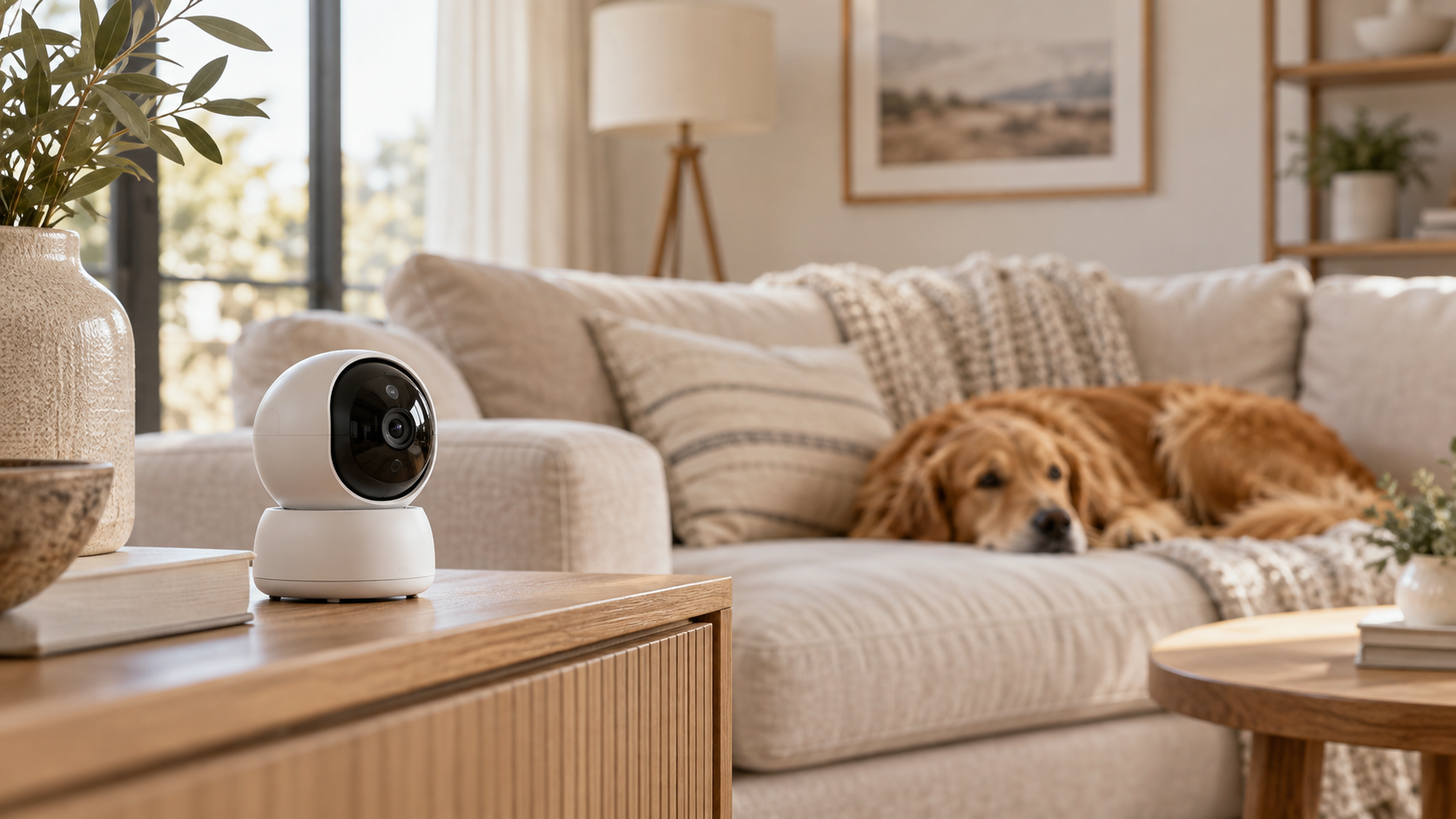
A pet camera for separation anxiety can be much more than a way to check whether your dog is sleeping on the couch. Used thoughtfully, video can help you identify your dog's earliest stress signals, estimate how long they currently remain comfortable alone, and adjust training before mild concern becomes panic. The goal is not to watch constantly or wait for your dog to become severely distressed. Instead, use the camera as a behavior-monitoring tool that helps you keep alone-time practice as manageable and predictable as possible.
A camera cannot diagnose separation anxiety, but it can show you something that is otherwise difficult to know: what your dog actually does after you walk out the door.
Why Video Is So Useful for Separation Anxiety
Without video, owners often have to guess what happens during an absence.
You might come home to an untouched Kong and assume your dog was anxious. Or you might return to a quiet home and assume everything went perfectly.
Neither conclusion is necessarily correct.
A dog may ignore food and peacefully sleep. Another dog may bark for 20 minutes and become quiet shortly before the owner returns. A third may spend an hour silently pacing without destroying anything.
Video provides behavioral context.
A dog camera for separation anxiety can help you observe:
- How quickly your dog reacts after you leave.
- Whether they can settle.
- Which behaviors appear first.
- Whether stress increases or decreases over time.
- Whether food or enrichment genuinely helps.
- Whether a crate, room, or free-roaming setup changes behavior.
- How long your dog appears comfortable before stress begins.
This is especially important because separation-related distress is not always dramatic. Some dogs bark, scratch doors, or attempt to escape. Others show quieter signs such as repeatedly changing position, staring at the exit, or remaining too vigilant to sleep.
If you are still trying to determine whether your dog's behavior fits a separation-related pattern, review the signs of separation anxiety in dogs.
It can also help to compare separation anxiety vs. boredom in dogs, because video can reveal important differences between a dog who is distressed and one who is simply looking for something to do.
What to Watch During the First Minutes After Leaving
The first part of an absence can be particularly informative.
Do not watch only for dramatic behaviors such as barking or destruction. Subtle changes may appear earlier and help you recognize when your dog is approaching their current tolerance limit.
Orientation toward the exit
Notice whether your dog keeps staring at the door, hallway, window, or other place associated with your departure.
A brief glance is normal. Repeated fixation may suggest increasing concern.
Pacing
Watch for repeated routes through the house, especially between doors and windows.
A dog who walks around briefly and then settles is different from a dog who repeats the same path without being able to rest.
Scanning the environment
An increasingly worried dog may repeatedly look around, listen intently, move toward sounds, or check several exits.
This vigilance can appear before obvious vocalization.
Panting
Panting can occur because of heat, physical activity, or excitement, so it should always be interpreted in context.
However, new panting that begins after departure and increases alongside pacing or other stress signals may be relevant.
Repeated position changes
A dog who lies down, immediately gets up, moves somewhere else, lies down again, and repeats the cycle may be struggling to settle.
The behavior can be easy to miss without video.
Inability to settle
A relaxed dog may investigate briefly and then rest. A worried dog may remain physically active or intensely alert throughout the absence.
Vocalization
Listen for:
- Whining.
- Repeated barking.
- Howling.
- High-pitched vocalization.
- Changes from occasional sounds to sustained vocalizing.
Timing matters. A single bark at an outside noise is not the same as sustained vocalization beginning immediately after you leave.
Food refusal
If your dog normally loves a particular treat but abandons it after you leave, stress may be competing with appetite.
Food refusal alone does not diagnose separation anxiety, but it becomes more meaningful when combined with pacing, panting, vocalization, or fixation on the exit.
Escape behavior
Watch carefully for scratching, biting, climbing, pushing, or throwing the body against doors, windows, crates, gates, or other barriers.
Frantic escape attempts can create a serious injury risk and deserve professional attention.
How to Establish an Alone-Time Baseline
A separation anxiety camera test is not about seeing how long your dog can endure being alone.
The goal is to estimate how long your dog can currently remain reasonably comfortable.
A simple process is:
- Choose a typical time of day when your dog is reasonably calm.
- Meet basic needs first, including an appropriate toilet opportunity.
- Set up your camera where you can see your dog's normal resting area and the main exit if possible.
- Begin recording before starting your departure routine.
- Leave in a normal, low-key way.
- Observe remotely.
- Look for the first meaningful change from relaxed behavior toward concern.
- Return before severe distress develops whenever practical.
- Write down what you observed.
Suppose your dog lies calmly for 40 seconds, sits up and watches the door at 45 seconds, starts pacing at 55 seconds, and begins whining at 70 seconds.
You would not necessarily consider 70 seconds the dog's comfortable baseline.
The earlier shift—perhaps around 40 to 45 seconds—may be more useful for planning the next training session.
When in doubt, begin easier rather than harder.
How to Record a Training Session
You do not need a complicated surveillance system to monitor your dog when home alone. A basic pet camera, home security camera, webcam, tablet, or spare phone may provide enough information.
Choose the camera position carefully
Place the camera where you can see as much of your dog's likely movement as possible.
Useful areas may include:
- The main exit.
- Your dog's bed.
- The crate or pen if one is being used.
- A hallway the dog commonly paces through.
- The sofa or other resting area.
If your dog moves between several rooms, one very narrow camera angle may miss important behavior.
Include sound if possible
Audio can reveal whining, barking, scratching, panting, outside noises, and other information that may not be obvious visually.
It can also help you determine whether barking corresponds with specific environmental sounds rather than your absence itself.
Make sure the dog's full body is visible
Body posture often tells you more than the dog's face alone.
A camera pointed too high or too close may miss pacing, repeated position changes, trembling, scratching, or attempts to leave the area.
Keep simple time notes
Note important points such as:
- Departure at 0:00.
- Dog stops eating at 0:35.
- Dog begins watching door at 0:48.
- First pacing at 1:05.
- First whine at 1:18.
These details are more useful for training than simply writing “dog became anxious.”
What "Below Threshold" Can Look Like on Camera
In separation training, below threshold generally means the dog is still able to cope with the exercise rather than progressing into significant distress.
There is no single behavior that defines threshold for every dog.
On camera, a dog remaining below threshold might:
- Look toward the door briefly and then disengage.
- Continue eating normally.
- Explore calmly.
- Lie down with relaxed body language.
- Change position occasionally without repeated restless movement.
- Respond to an environmental sound and then settle again.
- Rest or sleep.
The key is recovery.
A dog does not need to behave like a statue to be comfortable. Looking at the door once or changing sleeping positions does not automatically mean training has failed.
You are looking for whether mild reactions resolve or build into something larger.
For example, this sequence may still be manageable:
Looks at door → waits briefly → sighs → lies back down.
This pattern is more concerning:
Looks at door → stands → scans room → walks to door → paces → begins panting → whines → cannot settle.
The second sequence suggests the difficulty is escalating.
Signs You Increased Duration Too Quickly
Your camera can tell you when an increase that looked small on paper was actually too difficult for your dog.
Possible warning signs include:
- Stress appears earlier than it did in previous sessions.
- Your dog stops eating sooner.
- Pacing begins.
- Your dog repeatedly returns to the exit.
- Panting increases.
- Vocalization begins or becomes more sustained.
- Your dog cannot lie down and remain settled.
- The dog starts scratching at a door, crate, or barrier.
- Your dog takes noticeably longer to recover between repetitions.
If this happens, do not punish the behavior or keep extending the absence to see whether the dog eventually gives up.
Make the next repetition easier.
For example, if your dog was comfortable at 90 seconds but clearly struggled during a two-minute attempt, you might return to 45, 60, or 75 seconds depending on what the video showed.
Training does not have to increase in a straight line.
Create a Simple Training Log
A dog alone-time camera becomes much more useful when you combine observations with a simple written record.
You do not need complicated software. A notebook, spreadsheet, or notes app is enough.
| Date | Planned absence | First stress signal | Maximum comfortable duration | Notes |
|---|---|---|---|---|
| Monday | 30 sec | None observed | 30 sec | Ate Kong and remained relaxed |
| Tuesday | 45 sec | Looked toward door at 38 sec | About 35 sec | Settled again after return |
| Wednesday | 35 sec | None observed | 35 sec | Lay down after finishing treat |
| Thursday | 50 sec | Pacing at 43 sec | About 40 sec | Next repetition shortened |
| Friday | 40 sec | Brief door glance at 36 sec | 40 sec | Looked away and remained settled |
The numbers above are only examples. They are not a training schedule for every dog.
Recording patterns can help you notice details that memory tends to blur.
You may discover, for example, that your dog handles longer absences in the morning than late afternoon, struggles after noisy events, or becomes less comfortable after several difficult repetitions.
Should You Talk to Your Dog Through the Camera?
Many pet cameras include two-way audio. It can be tempting to speak to your dog when you notice them becoming worried.
Whether this helps depends on the dog.
Possible benefits
Some dogs may briefly relax after hearing a familiar voice.
Two-way audio can also be useful for ordinary communication with a dog who is already comfortable alone.
Possible drawbacks
Other dogs become more confused or aroused.
Your dog may hear you but be unable to find you, which can lead to more searching, pacing, barking, or attention toward the camera.
A dog may also begin depending on remote reassurance rather than becoming comfortable with the separation itself.
If you want to test the feature, observe the response objectively.
If hearing your voice produces:
- Relaxed body language.
- A quick return to resting.
- Less scanning or pacing.
it may be neutral or helpful for that dog.
If it produces:
- More barking.
- Searching through the house.
- Running toward the camera.
- Increased pacing.
- Visible confusion.
it may be better to leave the audio feature off during training.
The camera's most important role in separation training is usually observation, not remote interaction.
Are Treat-Tossing Cameras Helpful?
Treat-dispensing cameras can be useful enrichment tools, but they should not be viewed as a treatment for separation anxiety.
For a dog who is already relatively comfortable alone, remotely delivering an occasional treat may be enjoyable.
It can also be useful during certain training exercises if the dog understands the device and is not frightened by its movement or sound.
However, treat tossing has limitations.
If a dog is highly distressed, they may ignore the treat completely.
A dog who eats the treat and immediately returns to pacing is still struggling with the underlying absence.
And some dogs become highly focused on the machine itself, especially if it makes a distinctive sound before dispensing food.
Before relying on a treat camera:
- Introduce it while you are home.
- Make sure the dispensing sound does not frighten your dog.
- Confirm that your dog can safely eat the treats being used.
- Observe whether the device actually helps the dog settle.
- Avoid using food simply to distract a dog through an absence that is otherwise overwhelming.
If you are comparing camera types, our planned Furbo vs. Wyze dog camera comparison looks at features that matter for dog monitoring, including video, audio, and pet-specific functions.
What a Camera Cannot Diagnose
Video provides valuable information, but it cannot diagnose separation anxiety on its own.
A dog may pace because of:
- Separation-related distress.
- Outside noises.
- Pain or physical discomfort.
- Needing to toilet.
- Barrier frustration.
- Confinement distress.
- Another environmental trigger.
Likewise, barking while alone may have several causes.
The camera shows what happens. Determining why it happens sometimes requires broader assessment.
Veterinary evaluation is particularly important if behavior changes suddenly, especially when accompanied by appetite changes, vomiting, diarrhea, increased thirst, pain, lethargy, confusion, or other physical or behavioral changes.
Qualified behavior support is also appropriate when your dog:
- Attempts to escape through doors, windows, crates, or barriers.
- Injures teeth, nails, paws, or other body parts.
- Shows extreme or prolonged distress.
- Cannot tolerate even very short absences.
- Refuses food during absences despite normally being highly food motivated.
- Is not improving despite careful gradual training.
A video recording can be extremely useful to show your veterinarian or qualified behavior professional because it provides information that cannot be observed during a typical clinic visit.
Frequently Asked Questions
How long should I record my dog after leaving?
For an initial assessment, the beginning of the absence is especially useful because separation-related reactions often become apparent relatively early.
However, longer recordings can reveal whether your dog eventually settles, whether distress escalates, or whether environmental events later trigger behavior.
During active training, you may only need to monitor the short period you are practicing.
Do I need an expensive pet camera?
No.
The most important features for behavior monitoring are reliable video, an adequate field of view, and ideally sound.
Night vision can be helpful if you practice in low light.
Features such as treat dispensing, barking alerts, subscriptions, and two-way audio may be convenient but are not required for effective monitoring.
Where should I put the camera?
Choose a location that captures your dog's main resting area and, when possible, the exit associated with your departure.
A wide-angle view is usually more useful than a close-up view of one bed because separation behavior often involves movement between locations.
Should I watch my dog the entire time I am gone?
During early assessment and short training sessions, active observation can be very helpful.
You do not necessarily need to stare at a camera during every normal absence once you understand your dog's pattern.
The purpose is to gather useful information and support training, not to create constant surveillance that makes you increasingly anxious about every movement your dog makes.
How do I know whether my dog is sleeping or shutting down from stress?
Look at the overall body language and what happened before the dog became still.
A relaxed sleeping dog may shift positions naturally, breathe normally, stretch, and appear physically loose.
A dog who becomes unusually motionless after intense pacing, panting, or repeated escape attempts may require a more careful interpretation.
If you are unsure, save the video and discuss it with a qualified professional.
What if my dog only becomes anxious after 20 or 30 minutes?
That information is valuable.
It suggests the dog may have some ability to tolerate being alone but struggles once the absence exceeds a particular level.
For training, begin comfortably below the point where stress starts rather than repeatedly practicing at the failure point.
Should I use barking alerts?
Barking notifications can be convenient, but they do not replace watching the dog's behavior.
A camera may alert you only after vocalization has started, while earlier signs such as door fixation, pacing, panting, or food refusal may have appeared minutes earlier.
Use alerts as additional information rather than treating barking as the only measure of anxiety.
Can I use old recordings to measure progress?
Yes.
Comparing recordings over time can be very useful.
You might notice that your dog begins settling more quickly, watches the door less, continues eating longer, or tolerates greater duration before showing concern.
Those changes may represent meaningful progress even before you reach your eventual alone-time goal.
Use the Camera as a Training Tool, Not Just a Security Device
A pet camera for separation anxiety is most useful when it helps you understand your dog's behavior rather than simply telling you whether they are still inside the house.
Watch for the early details: orientation toward the exit, scanning, repeated position changes, pacing, panting, vocalization, changes in eating, and the ability—or inability—to settle.
Use those observations to establish your dog's current comfortable baseline and plan shorter, manageable absences.
If the video shows that your dog is becoming increasingly worried, make the next exercise easier rather than waiting for full panic.
Keep simple records so you can compare sessions and recognize patterns over time. A few notes about when stress started can be more useful than relying on memory alone.
Most importantly, remember what the camera cannot tell you. Video documents behavior; it does not provide a medical or behavioral diagnosis. Severe panic, self-injury, dangerous escape attempts, sudden behavior changes, or persistent difficulty being alone warrant veterinary and qualified behavior guidance.
Used that way, a camera becomes one of the most practical tools in gradual separation training: not a device for constantly checking on your dog, but a window into what your dog is experiencing when you are no longer in the room.