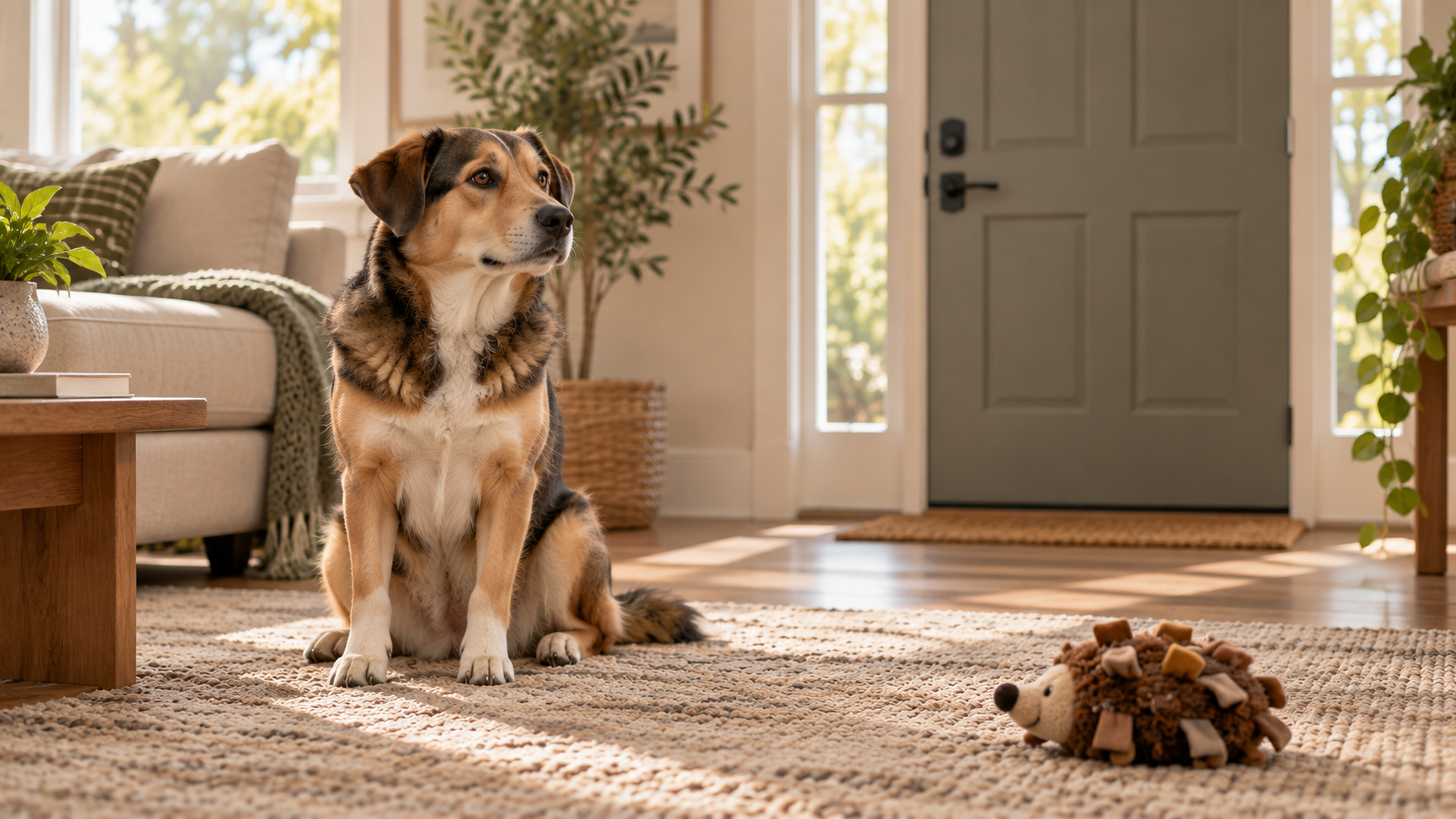
If your dog won't eat when home alone but eats normally when you are present, the change can be a sign of stress—especially if it happens alongside pacing, barking, panting, drooling, escape attempts, or an inability to settle. However, refusing food during an absence does not diagnose separation anxiety by itself. Dogs may ignore food because they are distracted, uncomfortable with something in the environment, uninterested in the food offered, or experiencing a medical problem that needs veterinary attention.
The most useful approach is to look at the entire pattern: what your dog does before you leave, what happens during the first minutes of the absence, whether they eventually eat, and whether appetite is normal at other times.
Why a Dog May Refuse Food When Left Alone
There are several reasons a dog might happily eat while you are home but leave a Kong, treat, meal, or lick mat untouched after you walk out the door.
Anxiety or stress
For some dogs, being left alone is emotionally difficult. When stress becomes strong enough, eating may become much less important than monitoring the environment, looking for the owner, pacing, vocalizing, or trying to escape.
An anxious dog may refuse food that they would normally eat immediately when a familiar person is nearby.
This pattern can be particularly meaningful when the dog approaches the food, seems interested in it, but repeatedly leaves it to stare at the door, follow sounds, pace, or search the house.
Distraction and vigilance
Not every dog who ignores food is panicking. Some dogs remain highly alert when alone.
They may spend the first part of an absence watching the front door, listening for footsteps, checking windows, or responding to sounds in the hallway or outside. Food may simply be less interesting while they are focused on what is happening around them.
Environmental changes
Something about the environment may make eating less comfortable when nobody is home.
Examples include:
- Construction noise nearby.
- People walking through an apartment hallway.
- Dogs barking outside.
- Delivery drivers approaching the house.
- Thunder, fireworks, or other sudden noises.
- A room becoming warmer or colder after you leave.
- Being confined somewhere the dog dislikes.
- A new home or recently changed routine.
A dog may therefore associate the absence with more than simply being separated from you.
The food may not be valuable enough
Some dogs are enthusiastic about ordinary kibble when people are present but less motivated to work for it when alone.
A partially filled Kong, dry treat, or unfamiliar enrichment toy may simply not be appealing enough to hold the dog's attention.
That is different from a dog who normally becomes extremely excited about a particular food but suddenly cannot eat it once you leave.
Medical considerations
Changes in appetite can also have medical causes. Dental pain, gastrointestinal problems, nausea, pain elsewhere in the body, medication effects, and many other health issues can influence how much a dog wants to eat.
If appetite has changed outside alone-time situations as well, the issue should not automatically be attributed to behavior.
Why Appetite Can Change During Stress
Eating normally requires a dog to feel safe enough to shift attention toward food.
When a dog becomes worried, attention may instead move toward whatever feels important or threatening. The dog may listen for the owner's return, monitor the exit, scan the environment, or repeatedly move around the home.
As stress increases, interest in food can decrease.
This does not mean every dog stops eating when anxious. Some dogs continue eating despite moderate stress, while others lose interest in food very quickly.
That individual variation is why appetite should be treated as one piece of information rather than a diagnostic test.
| What You Observe | What It May Suggest |
|---|---|
| Dog eats normally and then rests | The food and absence may currently be manageable. |
| Dog starts eating but repeatedly stops to watch the door | The dog may be becoming increasingly concerned. |
| Dog completely ignores a favorite food and begins pacing | Stress may be interfering with eating. |
| Dog ignores food but calmly sleeps | Lack of appetite may not be related to severe separation distress. |
| Dog refuses food both alone and when people are home | A medical or broader appetite issue should be considered. |
Signs the Problem May Be Separation-Related
A dog separation anxiety not eating pattern becomes more concerning when food refusal appears alongside other behaviors associated with distress during separation.
Watch for combinations of signs such as:
- Following you closely while you prepare to leave.
- Becoming restless when you pick up keys, shoes, or a bag.
- Staring at the door immediately after you leave.
- Pacing repeatedly.
- Whining, barking, or howling.
- Heavy panting unrelated to exercise or heat.
- Drooling more than usual.
- Scratching or biting at doors, windows, crates, or barriers.
- Repeatedly checking exits.
- Difficulty lying down or staying settled.
- Abandoning a favorite treat shortly after your departure.
- House soiling specifically during absences.
- Trying to escape from the home or confinement area.
The timing matters as much as the behavior itself. Separation-related distress often becomes noticeable shortly before departure or during the early part of an absence.
If several of these behaviors sound familiar, see our guide to the signs of separation anxiety in dogs.
It can also be useful to compare these behaviors with separation anxiety vs. boredom in dogs, because boredom and anxiety can produce some similar behaviors for very different reasons.
The Camera Test
One of the best ways to understand why your dog won't eat treats when alone is to record what actually happens after you leave.
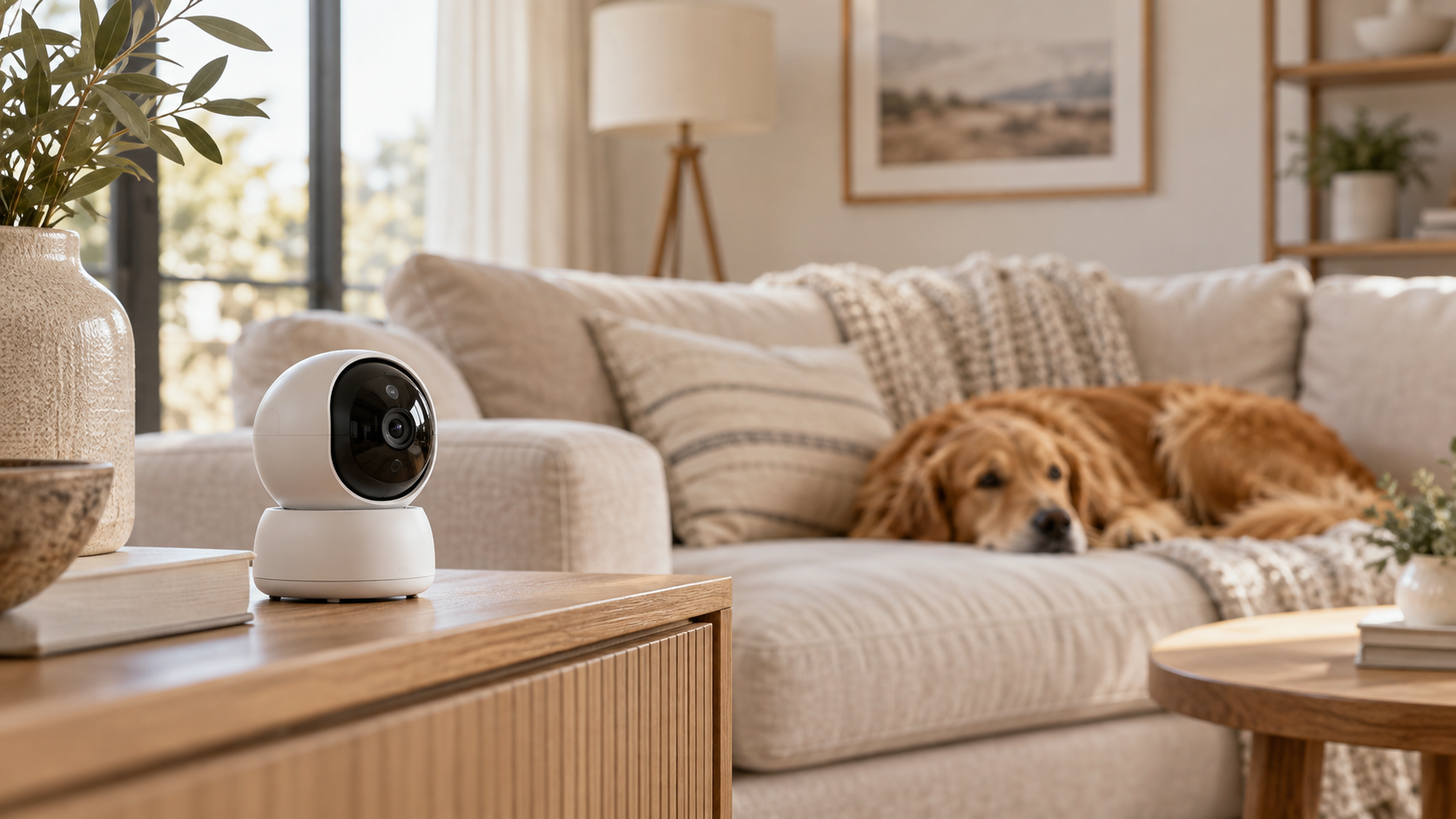
You do not need expensive equipment. A pet camera, security camera, laptop webcam, tablet, or spare phone may be enough.
Position the camera so you can see:
- The food toy or feeding area.
- The main exit you use.
- As much of your dog's body as possible.
- Any area where your dog commonly waits or paces.
Record at least the beginning of the absence. For many dogs with separation-related distress, the early minutes provide especially useful information.
Watch the recording from the moment you begin your departure routine.
Ask yourself:
- Does my dog begin eating immediately?
- Do they stop eating when the door closes?
- Do they repeatedly leave the food to check the door?
- Do they pace or vocalize?
- Can they lie down and relax?
- Do they return to the food later?
- Do signs of stress increase as time passes?
The difference between “my dog did not eat” and “my dog did not eat because they spent 20 minutes pacing and staring at the door” is extremely important.
The camera gives you behavioral context that an untouched Kong alone cannot provide.
What If My Dog Eats the Kong and Then Starts Panicking?
This is a common and important pattern.
You leave, your dog spends ten minutes working on a stuffed Kong, and everything appears fine. The Kong becomes empty, and then the dog begins pacing, barking, whining, or waiting intensely at the door.
In this situation, the food may have delayed the visible distress rather than changed how the dog feels about being alone.
That does not mean the Kong is useless. Enrichment can still make an absence more pleasant and can support relaxation for some dogs.
But if distress reliably begins after the food is finished, the dog may still need gradual alone-time training rather than simply a larger or longer-lasting food toy.
This distinction is important because it is easy to conclude that a dog is comfortable simply because they ate for the first few minutes.
Watch what happens afterward.
What If My Dog Will Not Touch Any Treat at All?
If your dog normally loves a particular treat but will not touch it once you leave, the training situation may be too difficult.
Instead of immediately searching for something even tastier, consider making the absence easier.
For example, if your dog ignores food when you leave for five minutes, you might test what happens during a much shorter separation.
Your starting point could be:
- Walking toward the door and returning.
- Opening and closing the door.
- Stepping outside for one second.
- Remaining outside for three seconds.
- Practicing a normal departure cue without actually leaving.
The correct starting point is whichever version your dog can handle without escalating distress.
If the dog is able to eat and remain relaxed during a three-second absence but cannot eat during a one-minute absence, that difference gives you useful information about the dog's current tolerance.
The goal is not to force eating. The goal is to reduce the difficulty enough that the dog can remain comfortable.
Can I Make the Food More Tempting?
Yes, within reason.
You can experiment with safe foods your dog already tolerates and enjoys. Depending on your dog's normal diet and veterinary guidance, options may include:
- Moistening regular kibble.
- Using part of the dog's normal meal in a food toy.
- Mixing kibble with a small amount of familiar wet dog food.
- Freezing an appropriate stuffed food toy so it lasts longer.
- Using a familiar lickable filling.
- Offering a favorite safe chew.
Avoid making sudden major dietary changes, especially if your dog has a sensitive stomach or a history of food intolerance.
Most importantly, richer food should not be used simply to mask panic.
If your dog will only eat extremely high-value food for a few minutes and then becomes frantic as soon as it is gone, the underlying separation difficulty still deserves attention.
Likewise, repeatedly increasing the richness of the food does not necessarily make an overwhelming absence emotionally easier.
When Food Toys Help—and When They Don't
Food toys can be excellent enrichment. They encourage licking, chewing, sniffing, and problem-solving, and many dogs genuinely enjoy them.
For dogs who are comfortable being alone, a stuffed Kong, snuffle activity, puzzle feeder, or lick mat can make departure time more enjoyable.
For mildly worried dogs, enrichment may also help create a positive routine around short absences.
You can explore additional options in our guide to enrichment toys for anxious dogs.
However, food toys have limits.
They are less useful as a stand-alone strategy when:
- The dog is too distressed to eat.
- The dog eats rapidly and panics immediately afterward.
- The dog repeatedly abandons the toy to monitor the door.
- The dog tries to escape despite having access to food.
- The dog shows severe vocalization, drooling, panting, or pacing.
- The dog has developed a strong fear response to departure itself.
In those cases, enrichment may still be part of the plan, but gradual separation training and professional guidance may be more important.
Why Does My Dog Stop Eating When I Leave the Room?
Sometimes the pattern appears even before a true absence.
You may notice that your dog eats while you stand nearby but stops the moment you walk into another room.
That does not automatically mean the dog has separation anxiety. Dogs often use social information from people around them, and some simply prefer eating when their owner is nearby.
However, it is worth paying closer attention if the dog also immediately follows you, abandons food despite being hungry, becomes restless, vocalizes, or seems unable to remain comfortably separated even inside the home.
The broader pattern matters more than the food behavior alone.
Do Not Force Your Dog to Eat
If your dog is nervous, avoid turning food into another source of pressure.
Do not push food into the dog's mouth, repeatedly command the dog to eat, restrain the dog beside a food toy, or punish them for leaving it untouched.
Food refusal is information.
If the reason is stress, adding pressure around eating may make the situation more uncomfortable rather than solving the underlying problem.
When to Contact Your Veterinarian
Because appetite is also a health indicator, not every change should be treated as a training problem.
Contact your veterinarian if your dog's appetite changes suddenly or if refusal to eat occurs outside periods of being alone.
Veterinary advice is especially appropriate if appetite changes occur with:
- Vomiting.
- Diarrhea.
- Abdominal discomfort.
- Signs of mouth or dental pain.
- Lethargy.
- Weakness.
- Unexpected weight loss.
- Changes in drinking.
- Difficulty chewing or swallowing.
- Other noticeable health or behavior changes.
A veterinarian can help evaluate medical factors before you assume the problem is purely behavioral.
You should also seek veterinary and qualified behavior support if your dog experiences severe distress when left alone, including self-injury, frantic escape attempts, extreme drooling, continuous panic, destruction around exits, or an inability to tolerate even very short absences.
For serious separation-related problems, an experienced force-free behavior professional can work alongside your veterinarian to develop an appropriate plan.
Frequently Asked Questions
Is refusing a Kong a sign of separation anxiety?
It can be one clue, but it is not enough to diagnose separation anxiety.
A dog who normally loves a Kong but ignores it only when left alone may be experiencing stress. The likelihood becomes more concerning when food refusal occurs with behaviors such as pacing, barking, panting, drooling, escape attempts, or inability to settle.
Use a camera to see what your dog does instead of eating.
Should I leave food out all day?
Leaving food available all day is not necessary as a treatment for separation-related distress.
Whether free-feeding is appropriate depends on your dog's individual health, feeding plan, appetite, and veterinary recommendations.
If you are trying to understand whether stress affects eating, scheduled meals can sometimes make appetite patterns easier to observe.
Do not make major feeding changes for a dog with health problems without discussing them with your veterinarian.
Can a dog be too anxious to eat?
Yes. Some dogs lose interest in food when they become highly stressed.
A dog may eagerly accept a favorite treat when you are present but completely ignore the same food during an overwhelming absence.
However, not every anxious dog stops eating, and not every dog who refuses food is anxious. Look at the whole behavioral pattern.
Does another dog help?
Sometimes companionship from another dog changes the situation, but it is not a reliable solution for separation anxiety.
If the dog's distress is specifically related to being separated from a particular person, another dog may make little difference.
Some dogs remain extremely distressed even when another pet is present.
For that reason, getting a second dog should not be treated as a guaranteed way to solve separation-related problems.
Should I feed before leaving?
You can feed your dog before leaving if that fits their normal routine, but the ideal timing varies between dogs.
Some dogs settle comfortably after a meal. Others enjoy receiving part of their meal through an enrichment toy as the owner leaves.
If your dog has exercise restrictions, digestive problems, a medical condition, or specific feeding instructions, follow your veterinarian's guidance.
The main question is not whether the dog was fed before departure, but whether they remain comfortable once you are gone.
Why does my dog ignore the Kong when I leave but eat it when I come back?
If your dog ignores a Kong when you leave and begins eating as soon as you return, stress may have been suppressing their interest in food during the absence.
A camera can help confirm whether the dog spent that time calmly resting or showing signs of concern.
If the dog was pacing, waiting at the door, vocalizing, or panting and then immediately relaxed enough to eat when you returned, the pattern deserves closer attention.
What if my dog eventually eats after I have been gone for a while?
That can mean several different things.
The dog may need time to settle before feeling comfortable enough to eat. They may initially be distracted by departure sounds. Or they may experience mild concern that decreases rather than escalates.
Again, video is more informative than the empty food toy alone. Watch what happens before the dog begins eating.
Does refusing food mean my dog is above threshold?
Not automatically.
For some dogs, refusing a favorite food is an early indication that the situation has become too difficult. For others, food motivation naturally varies.
Use appetite alongside body language, movement, vocalization, ability to rest, and other behaviors to judge how comfortable the dog appears.
Look at the Whole Pattern, Not Just the Food Bowl
When a dog won't eat when home alone, the untouched food can provide useful information—but it should never be interpreted in isolation.
A dog who ignores breakfast and peacefully sleeps on the couch presents a very different picture from a dog who ignores the same meal while pacing, panting, barking, and scratching at the front door.
Use a camera to observe what actually happens. Notice when eating stops, what your dog does instead, how quickly stress appears, and whether appetite returns when you come home.
If food refusal appears to be connected to distress, make the separation easier rather than trying to overpower the anxiety with increasingly tempting food. For dogs with significant separation-related problems, gradual, force-free training can help build comfort at a pace the individual dog can tolerate.
And if appetite changes occur outside alone-time situations, appear suddenly, or happen alongside vomiting, diarrhea, pain, lethargy, weight loss, or other health changes, contact your veterinarian.
The goal is not to diagnose your dog from a single behavior. It is to observe patterns carefully and use those patterns to decide what kind of support your dog may need.