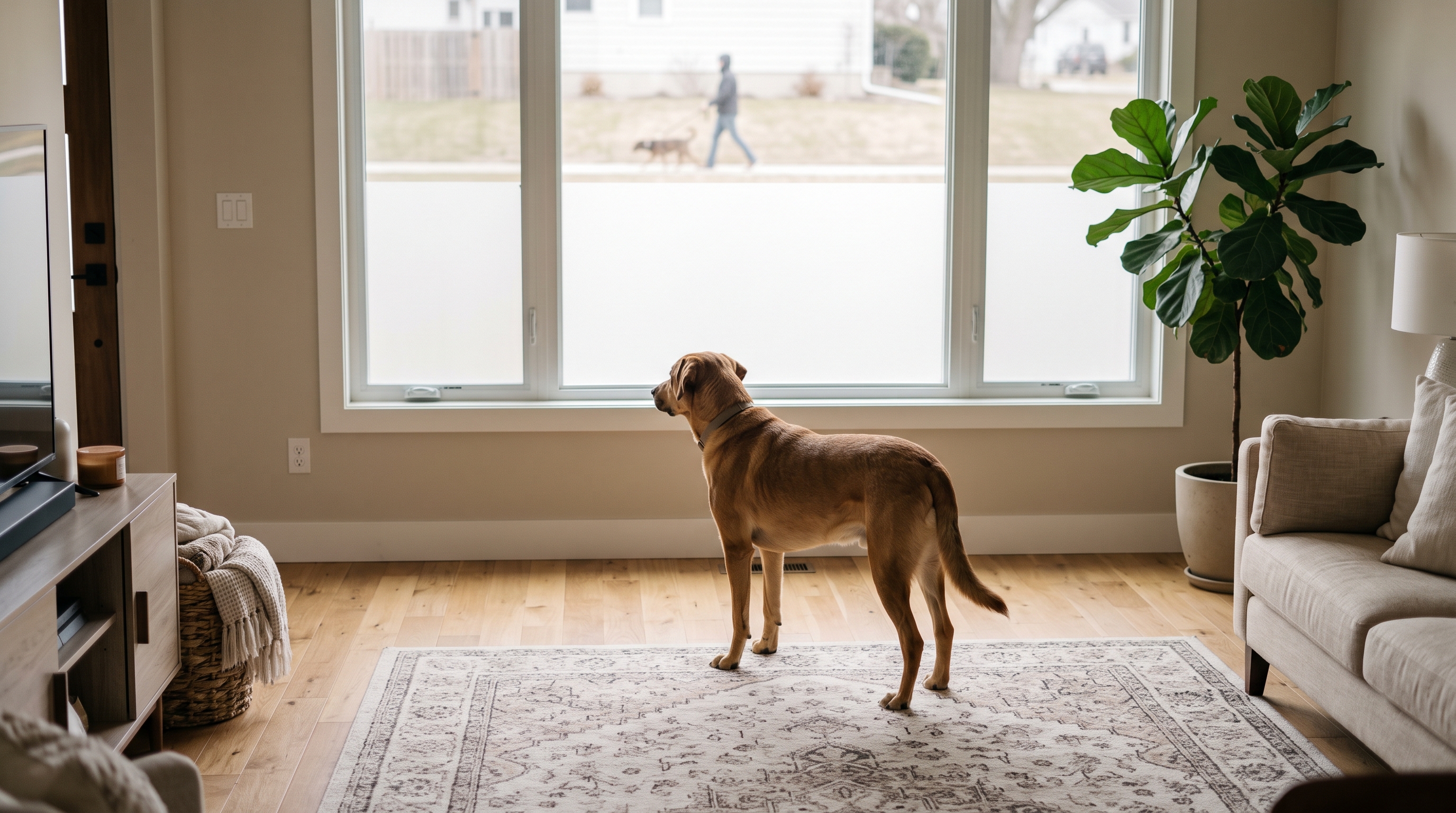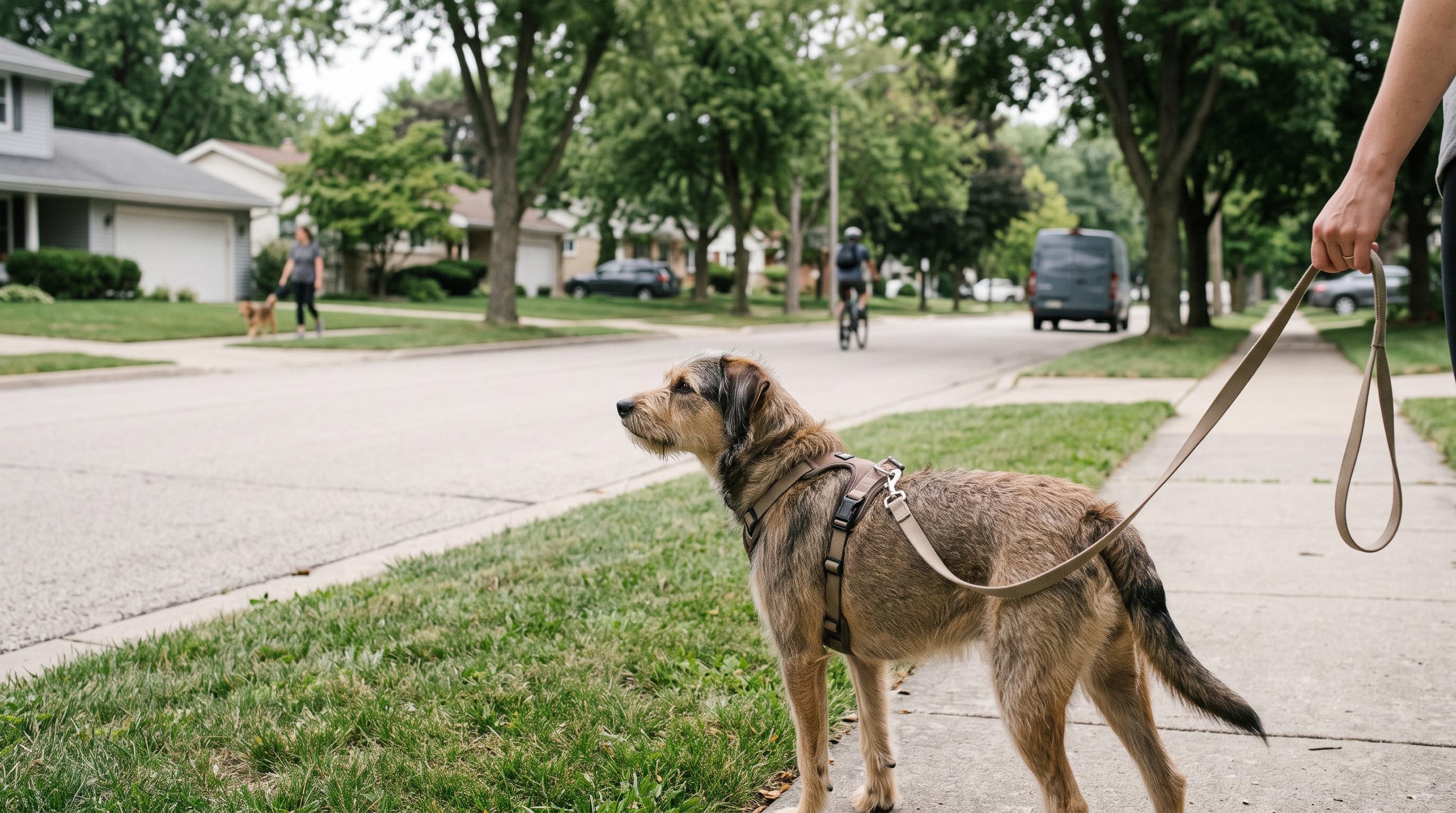
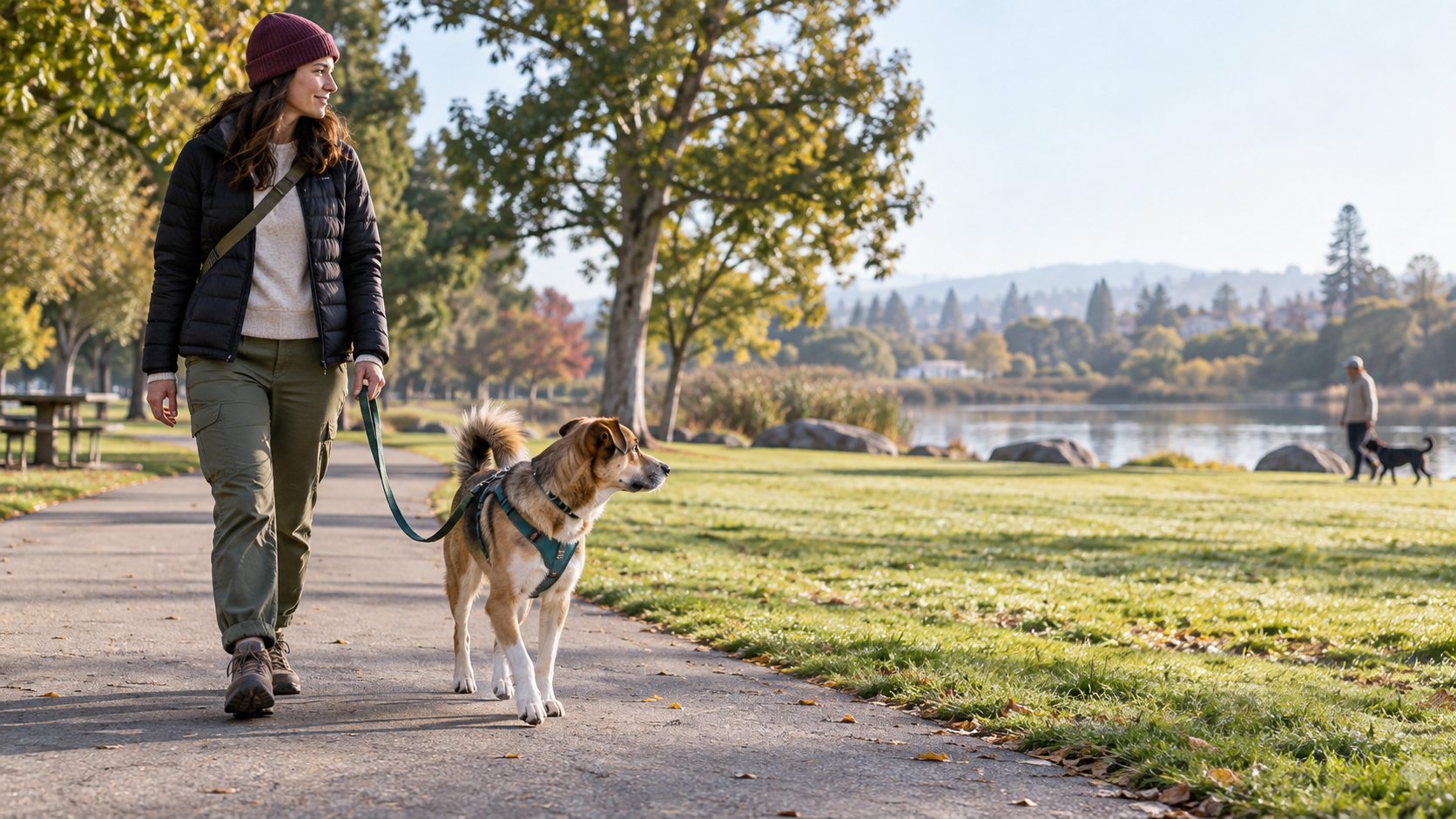
If you are wondering how to walk a reactive dog, the most important change is to stop measuring success by how closely your dog can pass another dog, person, or other trigger. Instead, choose routes with space to move away, watch for early stress signals, reward your dog while they can still cope, and use calm exits before barking or lunging escalates. A successful walk might be a quiet 15-minute sniffing session with no close encounters—and that can be far more beneficial than an hour spent struggling through stressful situations.
Walking a reactive dog can feel unpredictable, especially when your dog suddenly barks, pulls, or lunges at something that seemed harmless. But reactivity is not automatically aggression or disobedience. Dogs may react because they are frightened, frustrated, excited, overwhelmed, or uncomfortable. A force-free walking plan focuses on emotional safety, thoughtful management, and helping your dog develop more comfortable responses over time.
First, Redefine a Successful Walk
Many dog owners believe a successful walk means their dog passes other dogs politely, ignores every distraction, and walks calmly at their side.
For a reactive dog, those expectations may be too difficult at the beginning.
A better definition of success is a walk where your dog:
- Feels reasonably comfortable in the environment.
- Has opportunities to sniff and explore.
- Can notice triggers without becoming overwhelmed.
- Has enough distance to make comfortable choices.
- Can move away when a situation becomes difficult.
- Returns to a relaxed state after minor excitement.
- Finishes the outing without repeated intense reactions.
You do not need to prove that your dog can walk directly past every unfamiliar dog.
In fact, deliberately walking too close to triggers may create repeated stressful experiences rather than meaningful improvement.
A reactive dog also does not need to greet every dog or person to become more confident. Neutrality—being able to notice another dog without needing to approach or react—is a valuable goal.
The Dogs Trust guidance on reactive dogs recommends managing difficult situations by choosing quieter walking locations, creating distance, observing body language, and using reward-based training.
If you are unsure how reactivity differs from aggression, read our guide to reactive dogs vs. aggressive dogs.
Before You Leave the House
Preparing for a walk can make a significant difference. Good equipment, appropriate rewards, and a flexible route give you more options when something unexpected happens.
Choose a comfortable, secure harness and leash
Use equipment that allows you to maintain control without causing pain or restricting your dog's normal breathing.
A well-fitted Y-shaped harness can be a suitable option for many dogs because it distributes pressure across the body rather than concentrating force around the neck.
For dogs who are especially likely to back out of a harness, consider a properly fitted escape-resistant design.
A fixed-length leash, often around four to six feet depending on the environment and local leash rules, can provide practical control when passing obstacles or managing unexpected encounters.
Retractable leashes have limitations for reactive-dog walking. The extending cord can allow a dog to rush toward a trigger before you can shorten the distance, become tangled around people or animals, and make close-range management difficult. They are generally not a good choice when you need reliable control around nearby triggers.
A front-clip harness may help some handlers manage pulling, but fit matters, and equipment should not replace training.
Avoid prong collars, choke chains, shock collars, and leash corrections. These methods can add discomfort or fear to situations your dog already finds difficult.
The American Veterinary Society of Animal Behavior (AVSAB) recommends reward-based methods for dog training and behavior modification rather than aversive techniques.
Bring high-value rewards
Carry small, easy-to-eat treats your dog genuinely enjoys.
Options may include:
- Small pieces of plain, cooked chicken.
- Appropriate soft training treats.
- Small pieces of dog-safe cheese if tolerated.
- Part of your dog's regular food if it remains motivating outdoors.
- Another veterinarian-approved food your dog enjoys.
Keep treats small enough that your dog can eat them quickly without spending a long time chewing.
Some dogs prefer praise, movement, sniffing opportunities, or toys. Food is often convenient, but the reward should be something your dog actually values.
Plan quieter routes and times
Choose locations where your dog is less likely to encounter close, unavoidable triggers.
Good beginner walking areas may have:
- Wide paths.
- Clear visibility.
- Several possible exits.
- Space to cross the street safely.
- Fewer unfamiliar dogs.
- Less traffic and noise.
- Places where you can step aside.
Avoid narrow trails, crowded dog parks, busy sidewalks, and areas where unfamiliar dogs frequently approach without leashes if these environments overwhelm your dog.
Practice situational awareness
When walking a reactive dog, noticing the environment early can prevent difficult encounters.
Occasionally scan ahead for dogs, people, bicycles, skateboards, wildlife, or other known triggers.
You do not need to remain tense throughout the walk. The purpose is to recognize opportunities to create distance before a situation becomes difficult.
Learn Your Dog's Threshold Distance
Your dog's threshold distance is the approximate distance from a trigger at which they can still notice it without becoming overwhelmed.
This distance changes depending on the dog, the trigger, the environment, and the dog's emotional state.
For example, your dog might calmly notice another dog across a large field but begin staring intensely when that dog is half a block away.
At an even closer distance, your dog may bark, lunge, pull, freeze, or attempt to escape.
These reactions provide clues about where your dog is approaching or exceeding their current threshold.
Signs your dog may be below threshold
- Loose, relatively relaxed body posture.
- Ability to look away from the trigger.
- Willingness to take familiar treats.
- Ability to continue sniffing.
- Responding to a practiced cue.
- Moving comfortably with you.
- Briefly noticing a trigger and returning attention elsewhere.
Signs your dog may be approaching threshold
- Prolonged staring.
- Sudden body stiffness.
- Closed mouth and rigid posture.
- Increasing tension on the leash.
- Repeated scanning or fixation.
- Difficulty disengaging.
- Slower responses to familiar cues.
- Reduced interest in food.
Signs your dog may be over threshold
- Explosive barking or lunging.
- Frantic pulling.
- Intense growling or snapping.
- Attempts to flee.
- Freezing with severe tension.
- Inability to disengage from the trigger.
- Difficulty responding to familiar signals.
Do not assume one exact distance will always work.
A dog may feel comfortable around another dog at 100 feet on a calm morning but struggle at that same distance after construction noise, several stressful encounters, or poor sleep.
This relates to trigger stacking in dogs, where several challenging experiences can influence how strongly a dog reacts to the next event.
What to Do When You See a Trigger Before Your Dog Does
Spotting a trigger before your dog notices it gives you an excellent opportunity to manage the situation.
Imagine another dog is walking toward you on the opposite sidewalk.
Instead of waiting until your dog begins barking:
- Notice the approaching dog and estimate whether your current distance is comfortable.
- Decide whether to cross the street, turn around, or step onto a quieter route.
- Move calmly before your dog becomes highly focused on the trigger.
- Use a familiar cue if your dog has practiced it.
- Reward your dog for moving with you and remaining engaged.
- Continue toward a location where the trigger is less intense.
You do not need to make your dog stare at another dog to learn something from the encounter.
If the situation looks likely to become difficult, leaving early is often the best choice.
Avoid suddenly tightening the leash, pulling sharply, or shouting instructions. Those actions may increase tension and make the appearance of another dog predict discomfort.
The Emergency U-Turn
One of the most useful skills for a leash reactive dog is a cheerful emergency U-turn.
This teaches your dog to turn around and move with you when you give a familiar signal.
The purpose is not to physically pull your dog away. It is to build a practiced movement that becomes easy and rewarding.
Step 1: Start somewhere easy
Practice indoors, in a quiet yard, or in another familiar environment without nearby triggers.
Have several small treats ready.
Step 2: Choose a simple cue
Use a cheerful phrase such as:
- "This way!"
- "Let's go!"
- "Turn!"
Choose a phrase that feels natural and use it consistently.
Step 3: Say the cue and turn
Say your cue in a friendly voice, turn approximately 180 degrees, and begin moving in the opposite direction.
Encourage your dog to follow without jerking the leash.
Step 4: Reward following
As soon as your dog turns and follows, reward them generously.
You might give several small treats while moving away, followed by a chance to sniff.
Step 5: Practice repeatedly without triggers
Repeat the exercise in several easy locations.
Do not introduce the cue only when another dog appears. Your dog should already understand that turning with you predicts something positive.
Step 6: Introduce mild distractions
Practice around low-level environmental distractions while your dog remains comfortable.
Gradually build reliability before using the U-turn around more challenging triggers.
Step 7: Use it early during walks
When you notice a trigger approaching, say your practiced cue and move away before your dog reaches the point of barking or lunging.
If your dog is already overwhelmed and cannot respond, do not keep repeating the cue. Focus on creating distance safely.
Important: An emergency U-turn is a management skill, not a cure for reactivity. It helps prevent difficult encounters while other reward-based training builds more comfortable responses over time.
Using Distance as a Training Tool
Distance is one of the most valuable tools available when walking a reactive dog.
It changes how intense a trigger feels without requiring you to force your dog to tolerate a difficult encounter.
Consider a dog who reacts strongly to unfamiliar dogs.
At 20 feet, the dog may bark and lunge. At 60 feet, the dog may stare but still struggle to disengage. At 120 feet, the dog may notice the other dog, take treats, and continue walking comfortably.
In this example, the greater distance offers a more useful starting point for training.
These distances are illustrative, not universal recommendations. Your dog's comfortable distance could be much greater or smaller.
Over time, carefully planned training may help the dog remain comfortable at somewhat shorter distances.
However, do not continuously move closer simply because your dog has successfully completed one repetition.
A better approach is to:
- Begin at a comfortable distance.
- Reward calm observation and disengagement.
- Allow breaks between exposures.
- Increase distance whenever body language becomes tense.
- Only reduce distance gradually when your dog is consistently comfortable.
If your dog starts struggling, distance is not a failed training attempt. It is useful information about the current difficulty level.
When to Reward
Timing is important when working around triggers.
One useful reward-based technique involves pairing the appearance of a trigger with something the dog enjoys.
For example, when your dog sees another dog at a comfortable distance, you begin delivering small treats while the other dog remains visible.
When the other dog disappears, the treats stop.
With appropriately managed repetitions, this can help your dog develop a more positive emotional association with seeing other dogs.
A practical example:
- Your dog notices another dog in the distance.
- Your dog remains able to eat and respond.
- You calmly offer several small treats.
- The other dog continues walking away.
- You stop delivering treats once the trigger is gone.
- You give your dog time to sniff or relax.
Another helpful behavior to reinforce is voluntary disengagement.
If your dog notices another dog and then naturally looks back toward you, reward that choice.
Do not insist that your dog maintain constant eye contact with you or sit motionless while a trigger approaches.
If your dog begins staring intensely, refuses food, or becomes increasingly tense, the situation may be too difficult. Create more distance rather than attempting to solve everything with additional treats.
Food is not a tool for forcing a dog through panic. It works best as part of carefully managed training where the dog still has the capacity to cope.
These principles are consistent with RSPCA Queensland's reward-based guidance on lead reactivity and AVSAB's recommendations for humane behavior modification.
What to Do If an Off-Leash Dog Approaches
Unexpected off-leash dogs are one of the most stressful situations for many owners of reactive dogs.
Your priority is preventing injury, avoiding confrontation, and finding a safe way to leave.
If the approaching dog is still far away
- Change direction immediately if a safe exit is available.
- Create distance before the dog gets closer.
- Ask the other owner to call their dog back.
- Use a clear statement such as "Please call your dog. Mine needs space."
- Move behind a safe visual barrier if one is available.
If the dog is approaching quickly
Try to remain as composed as possible.
Avoid running, as sudden movement may increase excitement or pursuit in some dogs.
If the environment allows, continue moving away toward a safer area.
A parked car, sturdy fence, closed gate, or another solid barrier may help prevent direct contact.
Depending on the situation, calmly tossing a handful of treats away from your dog may briefly distract a food-motivated approaching dog and create an opportunity to leave. However, this is not reliable for every dog and should not be used if it creates competition or brings dogs closer together.
If direct contact seems unavoidable
Prioritize your own physical safety as well as your dog's.
Avoid putting your hands between dogs or grabbing unfamiliar dogs near their mouths.
Do not assume you can safely pick up your dog, especially if doing so exposes you to bites or causes the approaching dog to jump higher.
Use the safest available exit or solid physical barrier. If dogs begin fighting or someone is injured, seek appropriate veterinary or medical attention.
For dogs with a history of biting, a properly fitted basket muzzle introduced gradually through positive reinforcement may offer an additional layer of safety. A muzzle does not change the emotional cause of reactivity and should never be used as permission to force close encounters.
What If Your Dog Explodes Anyway?
Even with careful planning, difficult moments happen.
Perhaps another dog suddenly appears around a corner. A skateboard passes unexpectedly. Or your dog reacts before you have time to create distance.
If your dog begins barking, lunging, or pulling intensely:
- Focus on maintaining physical safety.
- Avoid shouting, scolding, or leash corrections.
- Move away from the trigger as safely as possible.
- Use a visual barrier or quieter route when available.
- Reduce further demands once the immediate situation is over.
- Allow your dog an opportunity to settle and recover.
Do not attempt to make your dog sit and face the trigger as punishment or proof of obedience.
After the incident, your dog may remain more alert or reactive than usual.
Consider ending the outing or choosing a quieter route home.
Later, reflect on what happened:
- Was the trigger too close?
- Did it appear unexpectedly?
- Was the route too narrow?
- Had your dog already experienced several stressful events?
- Did you miss an early signal?
- Would a different route or earlier U-turn help next time?
This information is far more useful than blaming yourself or your dog.
If repeated exposures appear to make your dog increasingly reactive throughout the day, our guide to trigger stacking in dogs explains why recovery and reducing unnecessary stress matter.
How Long Should Reactive-Dog Walks Be?
There is no universal ideal walking duration for reactive dogs.
The appropriate length depends on:
- Age and physical health.
- Fitness and mobility.
- Weather and temperature.
- Environmental difficulty.
- Number and intensity of triggers.
- Ability to recover after challenging encounters.
- Opportunities for sniffing and exploration.
- Individual exercise and enrichment needs.
A short walk through a quiet environment may provide a better experience than a long walk through crowded streets.
For example, a calm 15-minute sniffing walk may be more suitable on one day than a 45-minute outing involving repeated barking and lunging.
Those durations are examples rather than targets.
Some dogs may comfortably enjoy longer walks in quiet places. Others may need shorter outings with more recovery time.
Look at the quality of the experience, not only the number of minutes or miles.
If your dog becomes progressively more reactive as a walk continues, that may be a sign to shorten future outings or change the route.
Alternatives on Difficult Days
Not every day needs to involve a challenging neighborhood walk.
If your dog has experienced several stressful events, is unusually reactive, or cannot avoid difficult triggers on your normal route, consider lower-pressure activities.
Sniffing opportunities
Sniffing allows dogs to explore their environment at their own pace.
A slow walk around a quiet block, yard, or other safe location may be more relaxing than repeatedly navigating crowded sidewalks.
Yard enrichment
If you have access to a safe, secure yard, you can provide supervised exploration, gentle games, or appropriate scent activities.
Check that fencing is secure and that your dog will not spend the time barking at nearby people or dogs.
Food puzzles
Stuffed food toys, snuffle mats, and simple puzzle feeders can provide enjoyable mental activity.
Choose challenges that are suitable for your dog's abilities and do not create additional frustration.
For ideas, see our guide to enrichment toys for anxious dogs.
Indoor nose work
Simple scent games can be practiced at home.
Try hiding a few treats around a familiar room while your dog waits nearby, then invite them to search.
Start with easy hiding places before making the activity more challenging.
Quiet locations
Some dogs benefit from visiting a calm, open area with clear sightlines and plenty of space.
If appropriate and available, a securely fenced private dog exercise field can offer additional freedom without close encounters with unfamiliar dogs.
Alternative activities do not remove the need for suitable physical exercise, toileting, or veterinary care. They simply give you more ways to meet your dog's needs when normal walking routes are especially difficult.
Sample Low-Stress Walking Routine
The following is an illustrative routine for a dog who can already walk comfortably in a relatively quiet environment.
It is not a fixed training schedule. Adjust every stage according to your dog's behavior.
Before the walk
- Check harness and leash fit.
- Prepare small rewards.
- Choose a quieter route.
- Consider whether your dog has already experienced stressful events.
- Make sure there is enough time to avoid rushing.
First few minutes: Settle into the environment
Begin somewhere familiar and relatively quiet.
Allow your dog to sniff and explore rather than demanding constant heelwork.
Notice their posture, movement, and ability to respond.
Middle of the walk: Observe and reward
Continue at a manageable pace.
When your dog notices a distant trigger while remaining comfortable, pair the sight of the trigger with rewards.
If your dog voluntarily looks back toward you, reinforce that choice.
If the environment becomes busier, increase distance or change direction.
Before a difficult encounter: Use your exit plan
If you see an unfamiliar dog approaching and the distance is becoming uncomfortable, use your practiced U-turn or another safe route.
Reward your dog for following and moving away.
End of the walk: Finish on a manageable note
Move toward a quieter area.
Give your dog an opportunity to sniff if they remain relaxed.
Return home before the outing becomes unnecessarily difficult.
After the walk: Allow recovery
Provide access to water, a comfortable resting area, and an opportunity to settle.
Consider keeping simple notes about:
- Which triggers appeared.
- Approximate distances.
- Early stress signals.
- Successful U-turns.
- Whether your dog recovered quickly.
- Anything that may help you plan the next walk.
Progress is easier to recognize when you look at patterns over several walks instead of judging one isolated outing.
Common Mistakes When Walking a Reactive Dog
Walking too close to triggers
If your dog repeatedly barks or lunges at close distances, more close encounters are not automatically helpful.
Begin at a distance where your dog has a better chance of coping.
Waiting until barking begins
Early signals such as freezing, staring, mouth closing, and body tension may appear before a larger reaction.
Act when you notice those changes rather than waiting until the situation becomes more difficult.
Forcing greetings
Your dog does not need to greet every unfamiliar dog.
Allowing an unwanted approach may increase fear or frustration rather than build confidence.
Using punishment to suppress reactions
Yelling, jerking the leash, or using aversive collars may suppress visible behavior without resolving the underlying emotional response.
Use humane management and reward-based training instead.
Assuming every dog needs the same distance
Different dogs have different tolerances. Even the same dog may need more space on some days.
Training through every difficult situation
Sometimes the most appropriate decision is simply to leave.
Not every unexpected encounter needs to become a training exercise.
When to Get Professional Help
Some dogs need more individualized support than a general walking plan can provide.
Contact your veterinarian and consider a qualified, reward-based behavior professional if your dog:
- Has bitten or attempted to bite a person or animal.
- Frequently lunges with enough force to create a safety risk.
- Cannot recover after seeing triggers.
- Shows intense fear during ordinary walks.
- Becomes increasingly reactive despite careful management.
- Cannot remain comfortable at any practical walking distance.
- Has sudden changes in behavior.
- Shows signs of pain, illness, or physical discomfort.
- Is difficult to manage safely because of strength or escape behavior.
Medical issues, including pain, can influence behavior and tolerance. Veterinary evaluation is especially important when reactivity begins suddenly or becomes noticeably worse.
Look for a professional who uses reward-based methods and has experience with canine fear, frustration, reactivity, and behavior modification.
A veterinary behaviorist can be particularly helpful when reactions are severe or complicated.
Frequently Asked Questions
Should I make my dog sit when another dog passes?
Not necessarily.
For some dogs, sitting quietly at a comfortable distance is manageable. For others, being required to remain stationary while another dog approaches makes the situation more difficult.
If your dog becomes tense or fixated, moving away may be a better choice than insisting on a sit.
Is it okay to cross the street when another dog approaches?
Absolutely.
Crossing the street, when it is safe to do so, is a practical management strategy that creates distance and helps prevent overwhelming encounters.
It is not failure or avoidance caused by poor training.
For many reactive dogs, having enough space is what makes successful learning possible.
Will avoiding other dogs make my dog's reactivity worse?
Thoughtful management is different from avoiding every trigger forever.
Reducing unnecessary close encounters can prevent repeated overwhelming experiences while you work on gradual behavior change.
Structured, manageable exposure at a comfortable distance can still be part of a long-term plan.
The goal is not permanent isolation. It is appropriate exposure without forcing your dog over threshold.
Can I use treats forever?
Yes. Rewards are a normal part of maintaining behaviors you want to encourage.
As skills improve, you may naturally vary the frequency or type of reinforcement in familiar, easy situations.
However, there is no reason to stop providing rewards simply because your dog has improved.
For emotionally difficult situations, continued positive associations may remain useful.
Can reactive dogs improve?
Yes, many reactive dogs can make meaningful progress with appropriate management, reward-based behavior modification, and individualized support.
Improvement might mean fewer intense reactions, quicker recovery, greater comfort at previously difficult distances, or an increased ability to disengage from triggers.
Not every dog will become comfortable greeting unfamiliar dogs, and that does not need to be the goal.
Progress should be measured by welfare, safety, and functional improvement rather than by forcing social interactions.
Why does my dog lunge at other dogs on walks?
Lunging can have several motivations.
Some dogs are afraid and want unfamiliar dogs to move away. Others are excited or frustrated because the leash prevents them from approaching.
Some dogs experience a combination of emotions.
Observe body language, distance, and the circumstances surrounding the reaction rather than assuming every lunge indicates aggression.
Should I let my reactive dog greet friendly dogs?
Not simply because the other dog is friendly.
A friendly dog can still feel overwhelming to a dog who needs more space.
Allow greetings only when they are appropriate, voluntary, safe, and comfortable for both dogs.
For some reactive dogs, calm parallel walking at a suitable distance may be a more appropriate starting point than direct greetings.
What if my dog refuses treats outside?
Food refusal can sometimes indicate that the environment is too stressful or distracting.
Try practicing in an easier location, increasing distance from triggers, or using rewards your dog normally enjoys.
Do not assume that a dog who refuses treats needs to be pushed closer to the trigger.
Some dogs are simply less food motivated outdoors, so consider body language and overall behavior as well.
How often should I practice the emergency U-turn?
Practice regularly in easy situations so that the cue remains familiar and rewarding.
Short, successful repetitions during calm walks can be more useful than introducing the cue only during emergencies.
Keep practice varied and enjoyable rather than repeating it until your dog becomes frustrated or tired.
Should I stop walking my reactive dog completely?
Not automatically.
Many reactive dogs can continue enjoying appropriate walks when routes, timing, distance, and expectations are adjusted.
However, if every outing produces intense panic or creates an immediate safety risk, temporary alternatives and professional guidance may be appropriate.
Your dog still needs suitable opportunities for toileting, movement, rest, and enrichment.
Better Walks Begin With More Space, Not More Pressure
Learning how to walk a reactive dog does not mean forcing your dog to tolerate every person, dog, or distraction they encounter.
It means learning to recognize what your dog can currently handle and arranging walks that support emotional safety.
Choose comfortable equipment, carry appropriate rewards, plan quieter routes, watch for early signs of tension, and create distance before a difficult situation becomes overwhelming.
Practice your emergency U-turn when your dog is relaxed. Reward manageable encounters, allow sniffing and recovery, and remember that leaving a challenging situation can be the right decision.
Some days your dog may handle situations that were difficult before. Other days, they may need more distance, a shorter walk, or a quieter activity at home.
That variation does not erase progress.
The goal is not a dog who silently endures every stressful encounter. It is a dog who gradually becomes more comfortable, has safer experiences, and can enjoy everyday walks without being repeatedly pushed beyond their limits.
With patient, force-free training and professional support when needed, walking can become a more predictable and positive experience for both you and your dog.