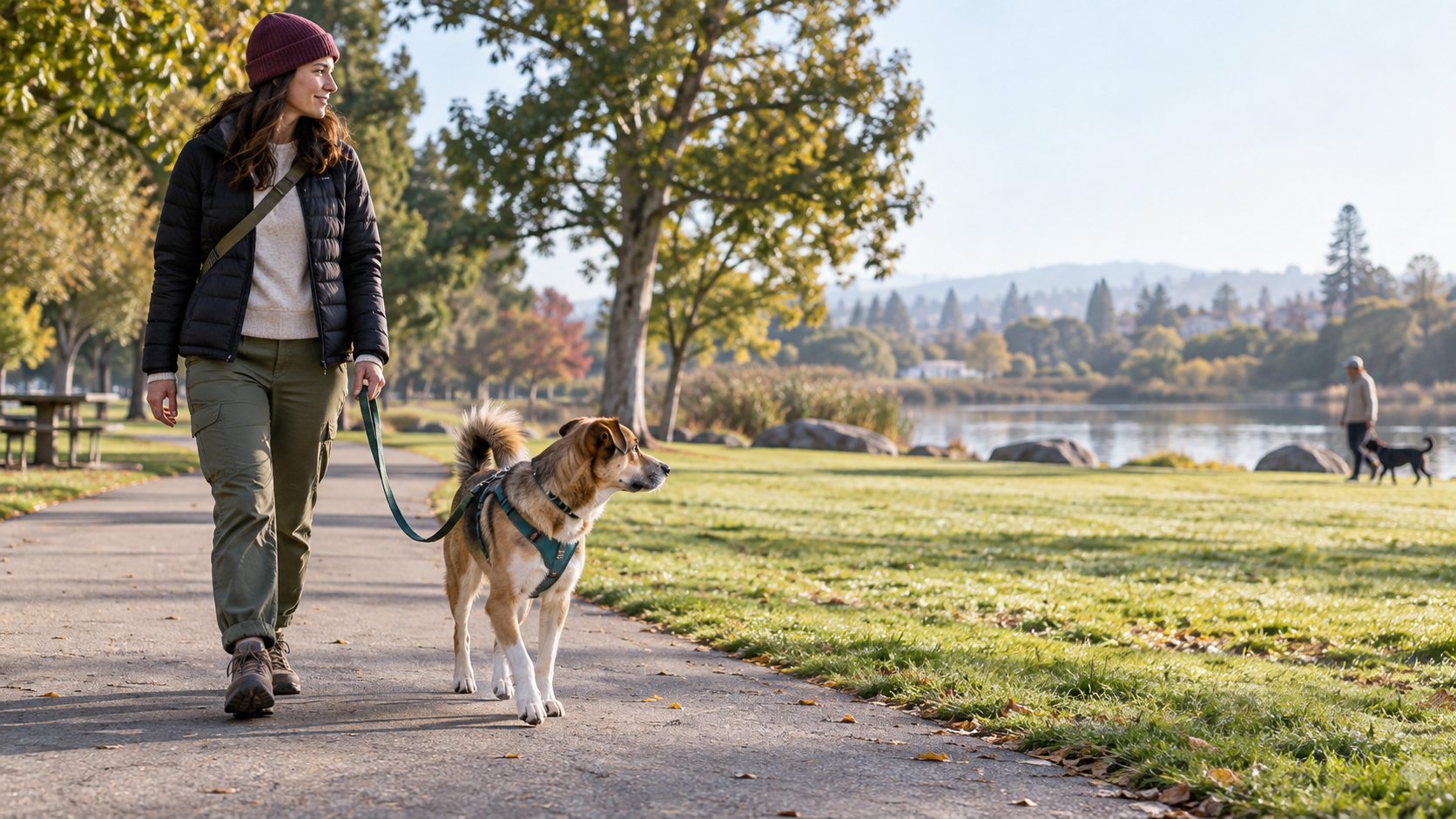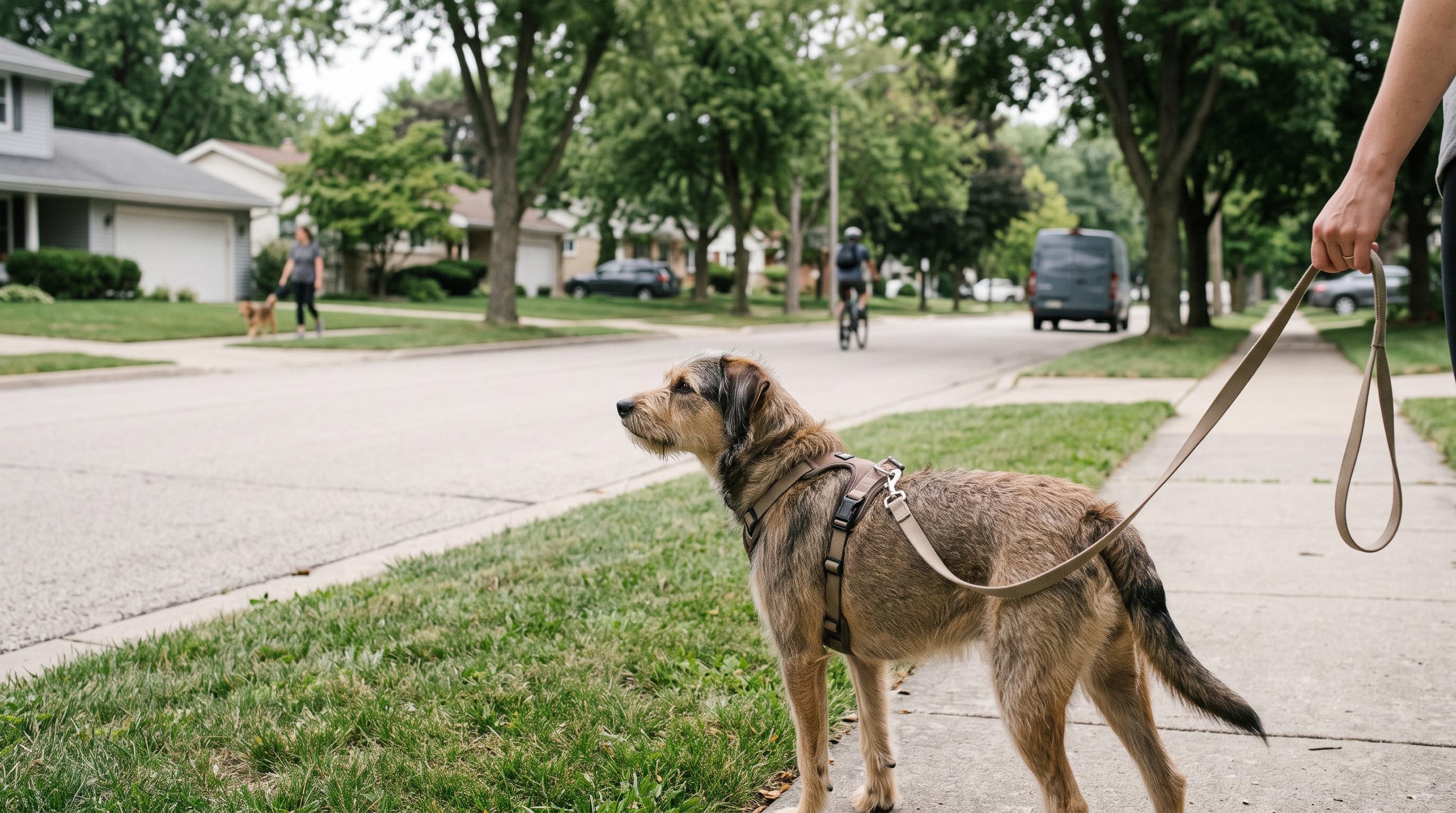
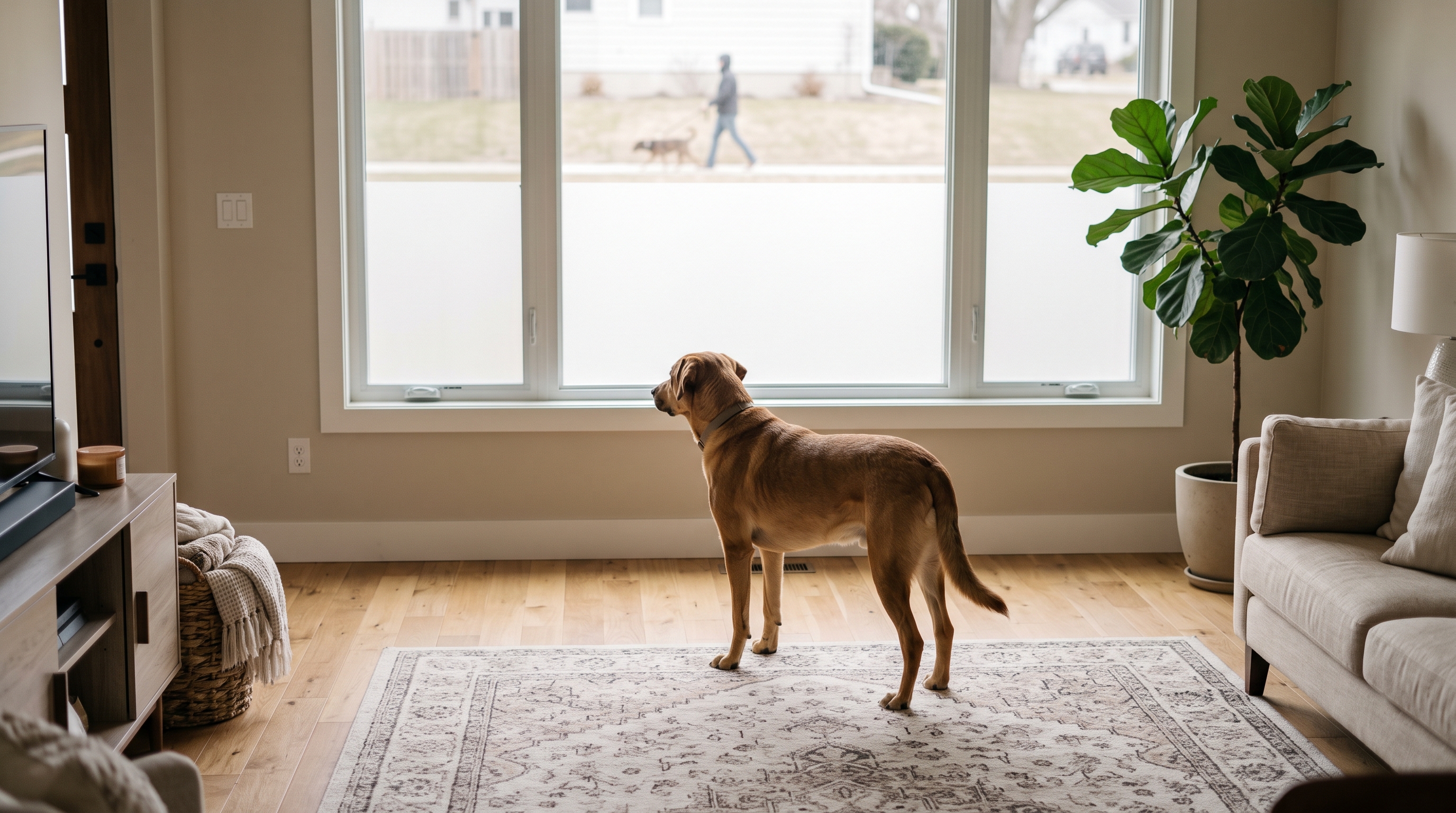
If your dog is reactive at the window, barking, lunging, growling, or racing toward passing people and dogs, the most effective first step is usually to reduce access to the view. Curtains, frosted privacy film, furniture changes, and baby gates can prevent repeated reactions while you teach a calmer response. Instead of punishing barking, use reward-based training to help your dog notice outside activity without becoming overwhelmed, and teach a simple cue to move away from the window.
Window reactivity can be frustrating, especially when your dog appears calm one moment and suddenly erupts at a pedestrian, delivery driver, cyclist, or unfamiliar dog. The good news is that you do not need to force your dog to watch more triggers or rely on punishment. With thoughtful environmental management, appropriate distance, and consistent practice, many dogs can develop calmer habits around windows.
Why Dogs React Through Windows
Dogs react through windows for several possible reasons. Although the behavior may look similar from one dog to another, the emotional motivation is not always the same.
Alert barking
Some dogs bark because they notice movement, unfamiliar sounds, or someone approaching the home.
A dog may hear footsteps, see a person approaching the driveway, or notice another dog across the street and begin barking to alert the household.
Alert barking is not automatically a sign of aggression. Dogs naturally respond to changes in their environment, but frequent alerting can become disruptive when every passing person triggers a prolonged reaction.
Fear or uncertainty
Some dogs find strangers, unfamiliar animals, bicycles, or sudden movements worrying.
A window can create a difficult situation because the dog can see the trigger but cannot easily investigate it or control the distance.
A fearful dog may bark or lunge in an attempt to make the perceived threat go away.
Watch for additional signs such as:
- Stiff body posture.
- Ears pinned back.
- Repeatedly moving toward and away from the window.
- Panting or trembling.
- Difficulty disengaging.
- Remaining vigilant after the trigger disappears.
Territorial behavior
Some dogs react strongly when people or animals approach areas they consider familiar or important, such as their home, yard, doorway, or driveway.
For example, a dog may ignore pedestrians during neighborhood walks but bark intensely when those same people pass the living room window.
This pattern can be consistent with territorial behavior, although it should not automatically be assumed that every barking dog is trying to defend property.
Barrier frustration
Barrier frustration in dogs occurs when a physical barrier prevents access to something the dog wants to approach or interact with.
A friendly, social dog might become highly excited when another dog passes outside. Because the glass prevents greeting or investigation, that excitement can turn into frustration.
The result may include:
- Barking.
- Jumping against the window.
- Whining.
- Pawing at the glass.
- Running repeatedly between rooms.
- Intense fixation on the passing dog.
Barrier frustration can look dramatic without necessarily indicating that the dog wants to harm the animal or person outside.
For more information about interpreting these behaviors, read our guide to reactive dogs vs. aggressive dogs.
Repeatedly practiced behavior
Sometimes the reaction has become a familiar routine.
The dog sees movement, rushes to the window, barks, and eventually the person or dog disappears.
Whether the original motivation was fear, excitement, territorial alerting, or frustration, repeated experiences can help establish a persistent behavior pattern.
The important lesson is that window reactivity is not a diagnosis. Understanding what happens before, during, and after the reaction helps you choose an appropriate response.
Why Repetition Can Make the Pattern Stronger
Imagine your dog spends several hours every afternoon looking through a window facing a busy sidewalk.
During that time, they might see:
- Six people walking past.
- Three unfamiliar dogs.
- A delivery driver.
- Two cyclists.
- Children returning from school.
If your dog reacts to every event, they may practice barking or lunging many times in a single day.
Over time, seeing movement outside may become strongly associated with rushing toward the window and barking.
In some cases, the sequence may also appear rewarding to the dog.
For example:
- A stranger approaches the house.
- Your dog barks intensely.
- The stranger continues walking and disappears.
- Your dog experiences the stranger leaving after the barking.
The stranger would probably have continued walking anyway, but the dog may learn an association between barking and the person disappearing.
This does not mean every instance of window barking is reinforced in exactly the same way. Different dogs have different motivations.
However, repeated rehearsal can make a behavior more automatic and difficult to interrupt.
The American Kennel Club's guidance on window barking emphasizes reducing access to triggers and teaching alternative responses rather than allowing the barking routine to continue uninterrupted.
That is why management should come before intensive training. Your dog needs fewer opportunities to practice the unwanted pattern while learning a different one.
Management Comes First
If your dog barks at people walking past the house, changing the environment may reduce reactions much faster than trying to interrupt every episode verbally.
Management does not mean giving up on training. It creates conditions where training is more likely to succeed.
Install privacy film
Frosted or opaque window film can block the view of pedestrians, dogs, vehicles, and other visual triggers.
For many homes, covering the lower portion of the window is enough to prevent the dog from watching sidewalk activity.
Advantages include:
- Reducing visual exposure while allowing some natural light.
- Providing consistent coverage throughout the day.
- Reducing the need to repeatedly close curtains.
- Helping prevent reactions when nobody is available to supervise.
Choose film appropriate for your window material and installation requirements.
Some dogs continue reacting to sounds even when the view is blocked, so privacy film may need to be combined with other strategies.
Close curtains or blinds
Curtains and blinds can provide an immediate, inexpensive way to reduce visual triggers.
If your dog reacts most strongly during particular hours, such as when children return from school or neighbors walk their dogs, close the curtains before that activity begins.
Avoid waiting until your dog has already become highly aroused.
Change the furniture arrangement
Some dogs stand on sofas, chairs, or window benches to watch the street.
If your dog uses furniture as a lookout point, consider moving the furniture farther from the window.
You can also establish a comfortable resting area on the opposite side of the room.
The goal is not to punish your dog by removing comfort. It is to make the window less accessible while offering an appealing alternative place to relax.
Use baby gates or other barriers
A baby gate can prevent access to a room with a particularly stimulating window.
For example, your dog may remain in a comfortable living area while the front hallway or street-facing room is temporarily restricted.
However, barriers should only be used if your dog tolerates them safely.
A dog who becomes frantic, attempts to jump a gate, or bites the barrier may need a different arrangement.
Change window access throughout the day
You do not necessarily have to block every window permanently.
Some dogs can enjoy looking outside when the environment is quiet but struggle during busy periods.
Consider allowing supervised window access during calm times while limiting access when known triggers are likely.
For dogs with severe window reactivity, longer-term visual management may be appropriate.
The Dogs Trust recommends environmental changes such as obscuring windows, adjusting furniture, and restricting access to problem areas as part of managing repetitive barking.
Teach a Better Response to Passing Triggers
Once you have reduced uncontrolled exposure, you can begin teaching your dog to respond differently when they notice people, dogs, or other activity outside.
This works best when your dog is still able to observe the trigger without escalating into significant distress.
In reward-based behavior modification, the goal is not merely to suppress barking. It is to help the dog form more comfortable associations and learn alternative behaviors.
Step 1: Find a comfortable starting distance
Begin far enough from the window that your dog can remain relaxed.
For one dog, that might mean standing several feet away. Another dog may need to begin in a different room with only a partial view of the outside environment.
Look for relaxed body language, willingness to take treats, and the ability to disengage from the window.
If your dog is already staring intensely, barking, or rushing toward the glass, the exercise is too difficult.
Step 2: Prepare high-value rewards
Use small pieces of food your dog enjoys and can eat easily.
For example, you might use:
- Soft training treats.
- Small pieces of plain cooked chicken.
- Part of a familiar meal if it is motivating.
- Another dog-safe food your dog tolerates well.
Keep the treats nearby so you do not have to search for them after a trigger appears.
Step 3: Pair manageable triggers with rewards
When your dog notices a person or dog outside at a comfortable intensity, begin offering small rewards.
For example:
- Your dog notices a person walking at a distance.
- Your dog remains loose and able to take food.
- You calmly deliver several small treats.
- The person continues walking and disappears from view.
- You stop delivering treats.
- Your dog has an opportunity to relax.
This is a simple example of counterconditioning: pairing the appearance of a trigger with something positive while keeping the experience manageable.
Do not force your dog to approach the window to receive food.
Step 4: Reward voluntary disengagement
If your dog notices someone outside and then looks away, turns toward you, or walks toward their resting area, reinforce that choice.
For example, your dog might glance at a cyclist and then look toward you.
You can mark that behavior with a calm "Yes" and deliver a treat away from the window.
Over time, your dog may become more practiced at looking away from triggers instead of remaining intensely focused on them.
Step 5: Keep sessions short and manageable
Stop while your dog is still coping comfortably.
Do not increase difficulty simply because one repetition went well.
If your dog begins staring, stiffening, pacing, vocalizing, or refusing food, increase distance or remove the visual trigger.
When possible, practice with a trusted helper walking at a planned distance outside, rather than relying entirely on unpredictable pedestrians.
This gives you greater control over the difficulty and timing of the exercise.
Step 6: Build skills gradually
As your dog becomes consistently more comfortable, you may gradually increase the visibility or proximity of manageable triggers.
However, there is no requirement to give your dog an unrestricted view of a busy street.
Some dogs benefit from keeping privacy film or other environmental management in place long-term.
That is a reasonable welfare-centered decision.
Teach a "Find It" or Move-Away Cue
A simple cue that encourages your dog to move away from the window can be extremely helpful.
Two useful options are a "Find It" game and a practiced move-away cue.
How to teach "Find It"
Begin when your dog is calm and there are no visible triggers.
- Say "Find it!" in a friendly voice.
- Drop one small treat on the floor close to your dog.
- Allow your dog to sniff and eat it.
- Repeat several times.
- Gradually scatter two or three treats across a small, safe area.
- Practice in different easy locations around the home.
- Once the cue is familiar, use it to guide your dog toward an area away from the window.
The goal is to create a predictable, rewarding activity that encourages sniffing and movement away from the visual trigger.
Do not scatter food directly beside a window where your dog is already lunging or likely to crash into the glass.
How to teach a move-away cue
You can also teach a phrase such as "This way!" or "Let's go!"
- Start in a quiet room.
- Say your chosen cue.
- Move a few steps away from your dog.
- Reward when your dog follows.
- Repeat until the movement becomes familiar.
- Practice near the window when there are no triggers.
- Later, use the cue when you notice your dog becoming interested in outside activity but before they become overwhelmed.
The cue should predict something positive, not the beginning of a correction or punishment.
If your dog is already highly aroused and cannot follow the cue, avoid repeating it louder and louder. Make the situation easier instead.
What to Do When Your Dog Is Already Barking and Lunging
If your dog lunges at the window and is already barking intensely, your first priority is safety and reducing stimulation.
This is usually not the best moment to begin a complicated training exercise.
Instead:
- Remain as calm as possible.
- Avoid shouting or physically correcting your dog.
- Close curtains or block the view if you can do so safely.
- Invite your dog away using a previously practiced cue.
- Create more distance from the window.
- Offer a quiet area where the dog can recover.
- Reduce additional stimulation while your dog settles.
If your dog is too distressed to respond to a familiar cue or eat a treat, do not keep insisting.
Wait until you can safely reduce the intensity of the situation.
After the episode, consider what triggered the reaction and how you might prevent the same situation from recurring.
A single difficult incident does not erase previous progress. It simply provides information about the current training setup.
Delivery Drivers and Predictable Triggers
Some of the most difficult window triggers are also the most predictable.
Delivery drivers, garbage collection, mail carriers, school dismissal, and neighbors walking their dogs may happen around similar times each day.
Use that predictability to your advantage.
Prepare before the trigger arrives
If deliveries usually happen in the afternoon, consider closing curtains and limiting access to the front window before that period begins.
You might also provide your dog with an appropriate food puzzle or safe chew in a quieter room.
The activity should be enjoyable rather than an attempt to force a highly distressed dog to remain occupied.
Adjust delivery arrangements when practical
Some delivery services allow customers to request that packages be left without ringing the doorbell.
A simple delivery note may reduce unnecessary barking triggers.
If your dog reacts to people entering the yard, consider whether a safe designated delivery location could help.
Practice with a helper
For controlled training, a trusted friend can simulate a person walking past the property at a comfortable distance.
Begin with a version your dog can handle.
Reward relaxed observation and disengagement, then gradually increase difficulty if your dog remains comfortable.
Do not repeatedly ask a helper to approach the window closely if your dog is already showing significant distress.
Apartments vs. Houses: Different Window Challenges
The best strategy for window reactivity in dogs depends partly on the living environment.
Apartment living
Apartment dogs may react to:
- People walking through shared hallways.
- Elevator sounds.
- Neighboring dogs.
- Movement in nearby buildings.
- Cars and pedestrians below windows.
- People entering shared courtyards.
Possible management strategies include privacy film, curtains, white noise at a comfortable volume, and moving resting areas away from windows or entrance doors.
In small apartments, baby gates may not be practical. In that case, reducing visibility and teaching a move-away cue can be especially helpful.
Pay attention to sound triggers as well as visual triggers.
Houses with yards or street-facing windows
Dogs living in houses may have direct views of sidewalks, driveways, neighboring yards, or other dogs behind fences.
Useful strategies include:
- Blocking the lower portion of street-facing windows.
- Moving furniture away from lookout spots.
- Creating a quieter resting area toward the back of the home.
- Managing access to front rooms during busy periods.
- Using appropriate fencing or visual barriers where safe and permitted.
- Preventing repeated running between windows and yard boundaries.
A dog who spends hours monitoring the street may benefit from fewer opportunities to patrol the perimeter.
Neither apartment living nor a house with a yard automatically causes reactivity. The important factors are the dog's individual response, frequency of triggers, and opportunities to recover.
Why Yelling Often Makes Things Worse
When your dog suddenly erupts at the window, shouting "Stop!" or "Quiet!" may feel like the fastest solution.
However, yelling can create additional problems.
First, your dog may already be highly aroused. A raised voice adds another intense stimulus to the situation.
Second, some dogs may interpret the shouting as their owner joining the commotion.
Third, punishment may create negative associations with people, dogs, or noises that already trigger concern.
Even if shouting interrupts barking briefly, it does not necessarily change the underlying emotional response.
The American Veterinary Society of Animal Behavior recommends reward-based training for behavior modification and advises against methods that rely on fear, pain, or intimidation.
Instead of yelling, focus on preventing repeated exposure, teaching an alternative behavior, and rewarding your dog while they are still able to respond.
If barking is a broader issue in your household, our guide to how to stop excessive dog barking explains why identifying the cause is essential.
Can Trigger Stacking Make Window Reactivity Worse?
Yes. A dog who has already experienced several stressful events may react more intensely to a window trigger later in the day.
For example, your dog might experience:
- Construction noise in the morning.
- An unfamiliar dog during a walk.
- Visitors arriving at lunchtime.
- A delivery driver in the afternoon.
- A person passing the window in the evening.
Even if the final trigger seems minor, your dog's ability to cope may already be reduced.
This pattern is commonly described as trigger stacking in dogs.
After a particularly stressful day, consider reducing unnecessary window exposure and offering opportunities for rest rather than introducing harder training exercises.
There is no universal recovery timetable. Observe your dog's behavior and adjust the environment to their needs.
When Window Reactivity Becomes a Safety Concern
Most window barking problems are frustrating rather than immediately dangerous, but certain behaviors require additional precautions.
Window reactivity may become a safety concern when your dog:
- Throws their body against glass.
- Repeatedly jumps onto unstable furniture.
- Scratches or bites window frames.
- Attempts to break through screens.
- Tries to escape through an open window.
- Falls or risks falling from an elevated surface.
- Redirects frustration toward another household dog or person.
- Snaps or bites when someone approaches during a reaction.
- Shows extreme distress that does not settle after the trigger disappears.
If these behaviors occur, prioritize preventing physical injury.
Restrict access to dangerous windows using safe, appropriate barriers and avoid handling your dog in ways that could place you at risk of a redirected bite.
A veterinarian or qualified reward-based behavior professional can help evaluate severe reactions and develop a safer plan.
Veterinary evaluation is also appropriate when reactivity begins suddenly or becomes significantly worse, particularly if there are signs of pain, illness, or other behavioral changes.
Common Mistakes That Can Slow Progress
Leaving the window fully accessible all day
If your dog repeatedly reacts to every passerby, occasional training sessions may not be enough to counterbalance hours of rehearsal.
Use management between training sessions.
Waiting until barking becomes intense
Intervening while your dog can still disengage is usually easier than attempting to interrupt a full reaction.
Training too close to the window
Standing directly beside the glass may be too difficult for a dog who reacts strongly to passing movement.
Increase distance or reduce visibility.
Using treats only after prolonged barking
Rewards are most useful when incorporated into a clear training plan rather than being used only as a last-minute attempt to interrupt panic.
Practice rewarding calm observation, voluntary disengagement, and movement away from the window.
Forcing the dog to watch triggers
Repeatedly exposing a frightened dog to overwhelming activity is not the same as gradual desensitization.
Your dog should have opportunities to move away and recover.
Expecting immediate silence
Progress may first appear as shorter barking episodes, less intense reactions, quicker recovery, or an increased ability to respond to familiar cues.
Those changes can be meaningful even if occasional barking continues.
Frequently Asked Questions
Why does my dog bark at people through the window but not on walks?
The home environment may change how your dog responds.
Some dogs become more alert or territorial near familiar property. Others experience frustration because the window prevents them from approaching or investigating someone outside.
During a walk, your dog may have more freedom to move away or explore.
The difference does not automatically mean the dog is aggressive at home.
Should I block my dog's view completely?
For dogs with frequent or severe reactions, blocking the view can be an effective management strategy.
Some dogs need only partial coverage, while others benefit from more complete visual barriers.
Observe whether your dog becomes calmer and rests more comfortably with reduced visual access.
Blocking the view does not mean depriving your dog of enrichment. You can provide other appropriate opportunities to sniff, explore, play, and observe the environment safely.
Will privacy film stop window barking?
Privacy film can substantially reduce barking triggered by visual movement outside, but it may not eliminate every reaction.
Your dog may still hear footsteps, vehicles, doorbells, or neighboring dogs.
For many households, privacy film works best as part of a broader plan that includes environmental management and reward-based training.
Is window barking a sign of aggression?
Not necessarily.
Dogs may bark through windows because of alerting, fear, frustration, excitement, or territorial responses.
The behavior alone does not reveal the dog's intention.
However, biting attempts, redirected aggression, or dangerous escape behavior warrant qualified professional assessment.
Should I teach my dog a "Quiet" command?
A positively trained quiet cue can be helpful for some dogs, but it should not be the only strategy.
If your dog is already highly distressed, asking for silence may be less effective than removing the trigger and creating distance.
Management and teaching a voluntary move-away behavior often provide a better starting point.
Can window reactivity affect leash reactivity?
It can be relevant, especially if the same triggers appear in both environments.
A dog who frequently becomes highly aroused while watching unfamiliar dogs outside may have fewer opportunities to practice calm responses.
However, window reactivity does not automatically cause leash reactivity. Both behaviors need to be evaluated in context.
What if my dog ignores treats when someone walks past?
Your dog may be too focused, stressed, excited, or frustrated to eat in that moment.
Move farther from the window, reduce the view, or practice when the outside activity is less intense.
Do not assume the solution is simply to offer increasingly valuable treats while leaving the difficulty unchanged.
How long does it take to reduce window reactivity?
There is no guaranteed timeline.
Progress depends on the frequency of triggers, the dog's emotional response, opportunities for management, previous learning, and consistency of training.
Some households may notice improvements soon after reducing visual access. Changing the dog's emotional response to triggers may take substantially longer.
Measure progress by comfort, reduced intensity, easier disengagement, and recovery rather than expecting complete silence by a particular date.
Should I let my dog watch outside as enrichment?
Watching the outside world can be enjoyable for some dogs.
However, it is not necessarily enriching for a dog who spends long periods barking, pacing, lunging, or remaining intensely vigilant.
If your dog cannot relax while monitoring the window, alternative enrichment such as sniffing games, appropriate chews, or calm exploration may be more beneficial.
What should I do when my dog reacts while I am not home?
Prioritize prevention before leaving.
Close curtains, use suitable privacy film, restrict access to problem windows if your dog tolerates the arrangement, and provide a safe resting area.
A camera can help you observe whether the environment is actually allowing your dog to settle.
If the dog shows severe distress while alone, consider whether separation-related concerns or other behavioral problems may also be involved.
Help Your Dog Feel Calmer, Not Just Quieter
When your dog is reactive at the window, the goal is not simply to stop the sound of barking. It is to reduce unnecessary stress, prevent dangerous reactions, and teach your dog a more comfortable way to respond to outside activity.
Start with management. Privacy film, curtains, furniture changes, safe barriers, and quieter resting areas can reduce the number of difficult encounters your dog experiences each day.
Then build a positive response through gradual, reward-based practice. Work at a distance where your dog can still cope, reinforce calm observation and voluntary disengagement, and teach a familiar "Find It" or move-away cue.
If your dog becomes overwhelmed, reduce the difficulty rather than shouting, punishing, or forcing continued exposure.
Progress may look like fewer reactions, less intense barking, quicker recovery, or your dog choosing to walk away from the window without being prompted.
Those improvements matter.
With patient management, consistent force-free training, and qualified help when necessary, many dogs can learn that people, animals, and vehicles passing outside do not require an intense response every time.
A calmer window routine can mean less stress for your dog, a more peaceful home, and more opportunities for everyone to relax.